
Short answer: if your priority is automation-first SOC 2 or ISO 27001 readiness with a large integrations library, Vanta is a strong fit, and its own documentation shows it also covers DORA, NIS 2, GDPR and the EU AI Act. If your priority is producing the artefacts an EU supervisor actually asks for, a machine-readable Register of Information, one incident classified against several regimes at once, and NIS2 duties at member-state resolution, that is the ground Venvera was built on.
Most people searching for a Vanta alternative for EU compliance assume the gap is framework coverage. It is not. Vanta’s public documentation lists DORA, NIS 2, the EU AI Act, GDPR and Cyber Essentials among more than 35 frameworks it supports. The useful question is narrower: when a competent authority asks for your register in the format the European Supervisory Authorities publish, when one outage starts DORA, NIS2 and GDPR clocks in the same hour, and when your NIS2 obligations depend on which member state transposed the directive, what does the tool actually put in your hands? This article compares the two on exactly that, and labels every line by how it was verified.
Compare Venvera and Vanta, framework by framework
This page is the broad EU-compliance view. For the framework or function you actually need to satisfy, go straight to the focused comparison.
Methodology
| Date reviewed | 14 July 2026. |
| Reviewer | Alexander Sverdlov, founder of Venvera. |
| Conflict of interest | Venvera publishes this comparison and is one of the two products assessed. Read it as a vendor document and evaluate both platforms yourself before deciding. |
| How capabilities were assessed | Venvera capabilities were checked directly in the product and are labelled verified in product. Vanta was not hands-on tested. Vanta capabilities come from Vanta’s own public pages and help centre, each linked below. Anything we could not find there is labelled not confirmed from public docs reviewed 14 July 2026, which means we did not find it, not that it is absent. |
| Customer evidence | None. Venvera is early and has no customer references to cite, so this article contains no testimonials, case studies, savings figures or ROI numbers. Product capability claims only. |
| Scope | The broad EU picture. For depth on DORA see the DORA comparison; for depth on risk registers, appetite and KRIs see the risk management comparison. |
What EU compliance asks for that a controls checklist does not
SOC 2 and ISO 27001 ask you to operate controls and evidence them. The EU regime adds a second job on top: submitting structured regulatory data, on the supervisor’s timetable, in the supervisor’s format. Three examples set the bar for any tool you shortlist.
- A register you can submit, not just maintain. The EBA states that DORA “became applicable on 17 January 2025” and that from that date all in-scope financial entities “will need to have a comprehensive register of their contractual arrangements with ICT third-party service providers available”. The templates come from Implementing Regulation (EU) 2024/2956, and the ESAs publish the taxonomy and reporting packages entities submit against.
- One incident, several clocks. A single ICT outage at a financial entity can start a DORA major-incident report, a NIS2 early warning and a GDPR Article 33 breach notification, each with its own trigger test and its own deadline. Classifying it once per regulation, by hand, in the first hours, is where teams lose time.
- NIS2 is a directive, not a regulation. Article 41 of Directive (EU) 2022/2555 required member states to transpose it by 17 October 2024. Your operative duties, your supervisory authority and your penalty exposure come from the national law, and those differ by country.
What Vanta’s own documentation says it does in the EU
A fair comparison starts by giving the other product its due, in its own words. From Vanta’s public pages, reviewed 14 July 2026:
The EU frameworks are covered
Vanta states it “supports 35+ frameworks, including SOC 2, ISO 27001, HIPAA, and GDPR, among many others”, and its framework list includes NIS 2, DORA and the EU AI Act (Vanta public docs).
A DORA product with RoI templates
Vanta’s DORA page says it “discovers shadow IT via IdP/SSO and device signals, inventories vendors, and helps you populate the Register of Information using ESA-aligned templates” (Vanta public docs).
EU hosting exists
Vanta announced an EU data centre: “Based in Frankfurt, Germany, our EU data centre is already up and running and operated by Amazon Web Services” (Vanta public docs). EU residency is a question to put to any vendor, not a difference to assume.
Auditors get their own portal
Vanta’s help centre says adding an audit firm “allows you to assign specific audit engagements to individual auditors that appear in an auditor portal they log in to” and “it does not grant them access to your Vanta account” (Vanta public docs).
Evidence automation is Vanta’s home turf: it states it “connects to 400+ integrations, continuously pulling in data to power monitoring and proactive, agentic workflows”. If most of your compliance work is collecting technical evidence from cloud, code, identity and device tools, that library is a real strength and you should weigh it heavily.
Four things Venvera does that we could not find in Vanta’s docs
1. A register that leaves the tool in submission format
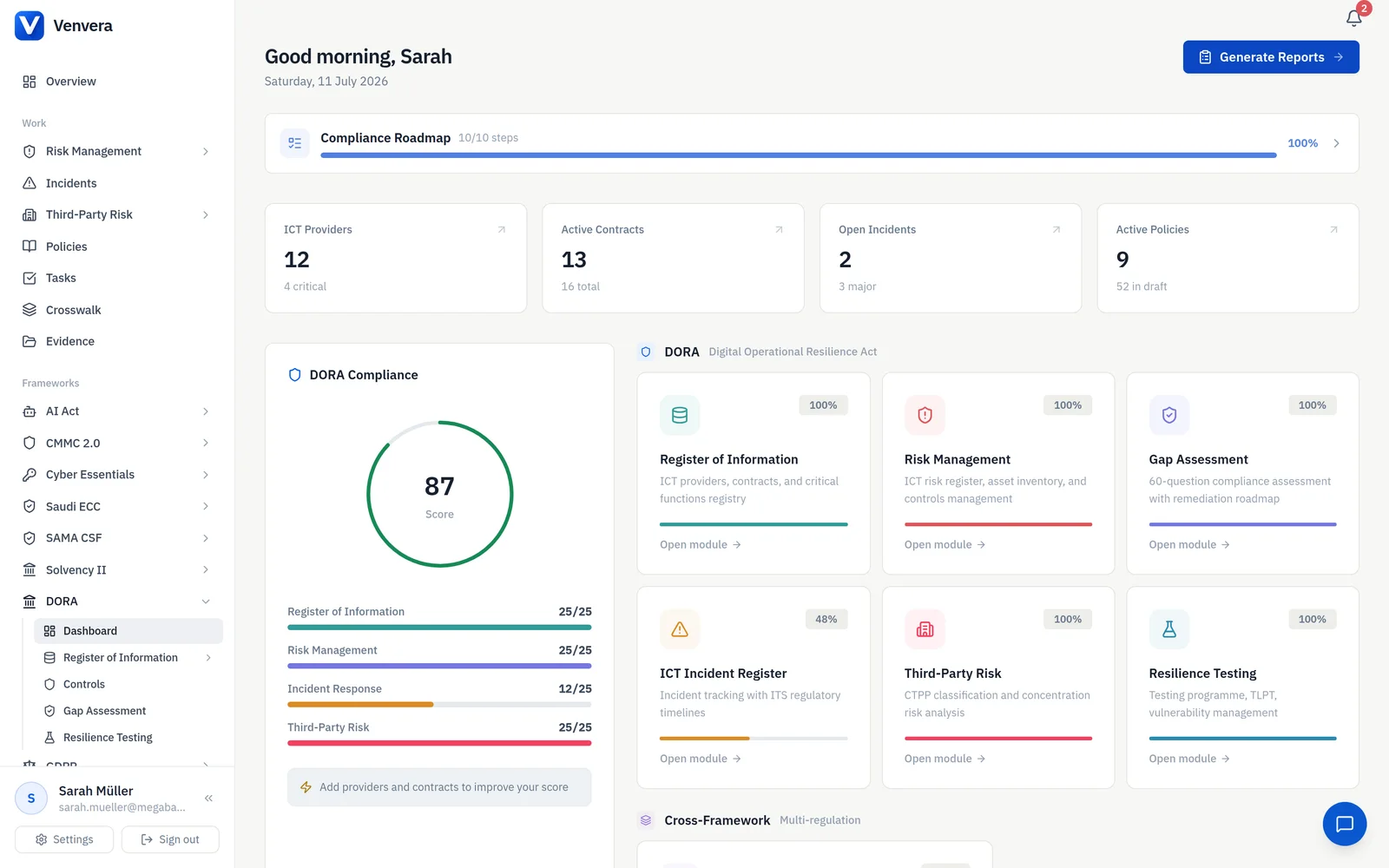
Venvera models the Register of Information as a relational dataset (ICT providers, contractual arrangements, business functions, branches, sub-outsourcing chains), ships the ESA entity-code library with LEI validation, and exports the register as xBRL-CSV against the ESA taxonomy (verified in product). Vanta documents ESA-aligned RoI templates, quoted above; a validated xBRL-CSV submission export was not confirmed from public docs reviewed 14 July 2026. Templates get you a populated register. A submission format gets you through the validation rules. More detail in the DORA comparison.
2. One incident, classified against four regimes at once
Venvera’s classification engine takes the incident attributes once and evaluates them against DORA, NIS2, GDPR and the EU AI Act together, returning which regimes are triggered, the classification under each, the reporting deadlines that follow, and a criterion-by-criterion justification, with a confidence level and one-click reclassification as the facts change (verified in product). Vanta documents ICT incident logging mapped to DORA requirements; classification against several regimes in a single pass was not confirmed from public docs reviewed 14 July 2026.
3. NIS2 at member-state resolution
Because NIS2 lands as national law, Venvera ships a transposition tracker covering 27 member states, each with transposition status, the national law, the supervisory authority, the national CSIRT and the notable national differences (verified in product). Country-level NIS2 transposition tracking was not confirmed from Vanta’s public docs reviewed 14 July 2026.
4. Pricing you can read before you talk to anyone
Venvera publishes flat-rate plans per organisation on its pricing page, with unlimited users and no per-user fees (verified in product). Vanta’s pricing page lists plan names but no amounts, and invites buyers to “Get personalized pricing” (Vanta public docs), so a like-for-like number depends on a sales conversation. That is a common enterprise model, not a scandal. It does mean you cannot budget from the website, and it means we give no Vanta figures here, because we have none we can source.
Doing the work once when several regimes apply
An EU financial entity is rarely under a single regime. In Venvera a control implemented once propagates to the equivalent requirements in the other frameworks you have enabled, and the crosswalk shows, domain by domain, where each framework stands (verified in product). Vanta also describes reusing evidence across frameworks in its own documentation, so treat cross-framework reuse as a shared idea and compare the depth of the mapping rather than its existence.
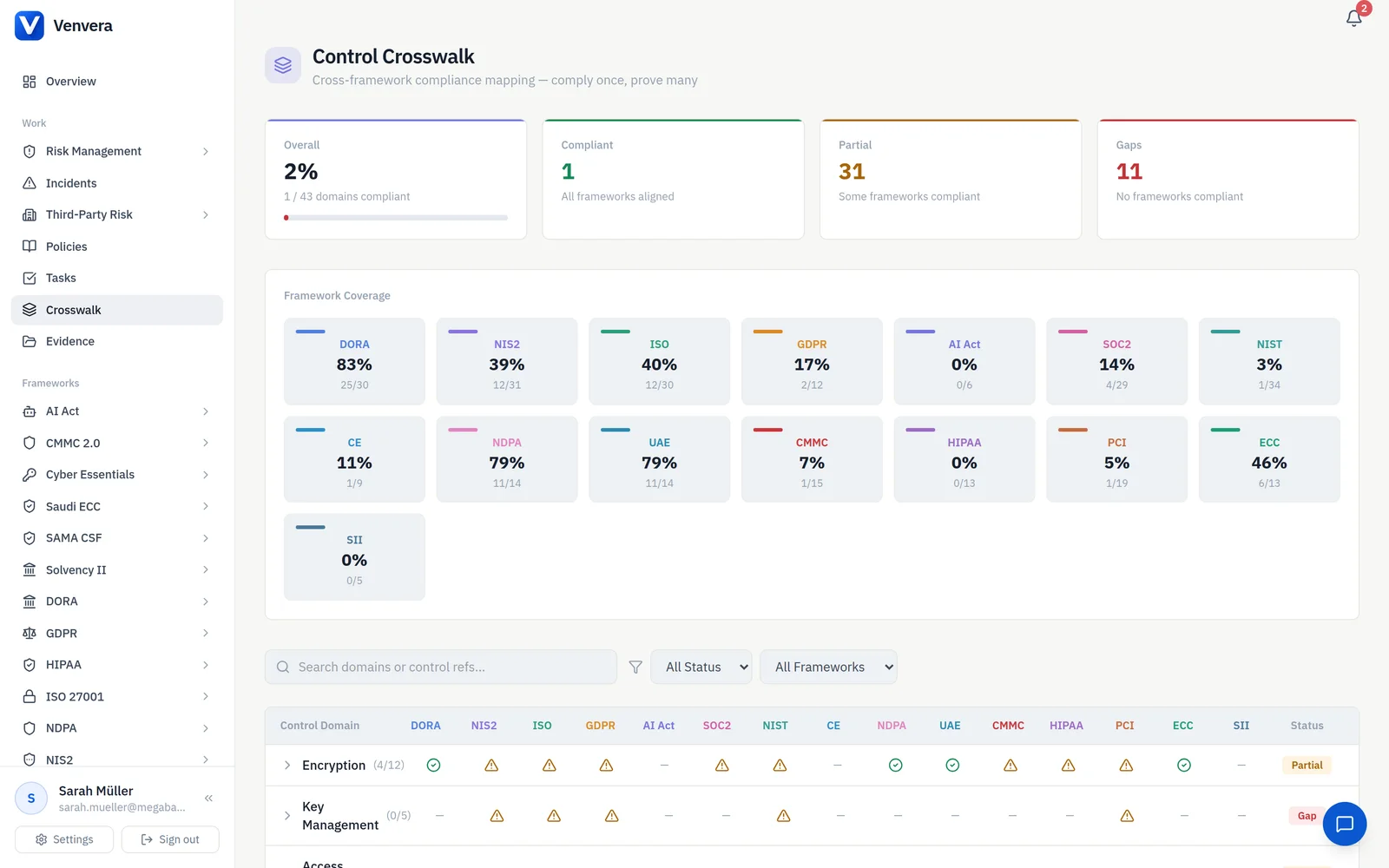
On top of that sit the layers a board and an auditor ask for, all verified in the product:
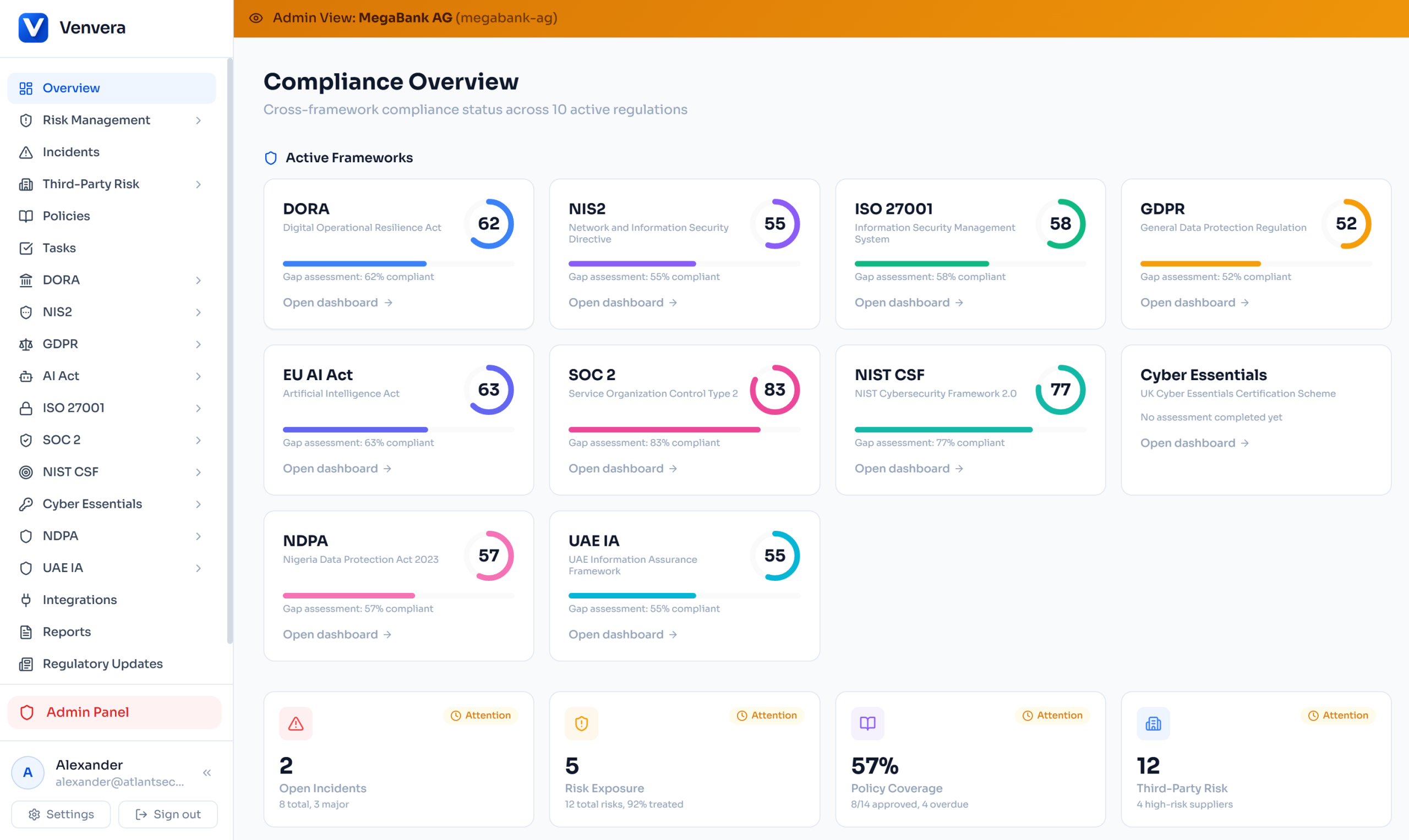
- A compliance health score: 0 to 100 per framework plus a weighted overall score, built from four signals, the gap assessment (worth up to 40 points), control implementation (30), operational health such as open incidents and overdue items (15), and policy coverage (15).
- An external auditor portal: magic-link invitation plus a 6-digit verification code shared separately, read-only enforced in middleware rather than only in the interface, access that expires on a set duration, and instant revocation.
- A vendor questionnaire portal: the vendor answers through a tokenised link plus a 6-digit code with no account to create, and the responses feed third-party risk.
- Board reports generated as DOCX per framework or across frameworks; a GDPR module covering processing activities, DPIAs, data subject requests, breaches, transfers and DPAs; and an EU AI Act module covering the system inventory, GPAI, conformity documentation, fundamental rights impact assessment and human oversight.
- EU hosting in Amsterdam, AES-256-GCM file encryption with per-tenant keys, and tenant isolation enforced by PostgreSQL row-level security in the database rather than only in application code.

Vanta and Venvera for EU compliance, line by line
Venvera lines are verified in the product. Vanta lines are either taken from Vanta’s public documentation, linked in the primary sources below, or marked as not confirmed from the public docs reviewed 14 July 2026. Not confirmed means we did not find it, not that it is absent. Verify current details with Vanta.
| Dimension | Venvera | Vanta |
|---|---|---|
| EU frameworks (DORA, NIS2, GDPR, EU AI Act) | Covered (verified in product) | Covered per Vanta docs (verify) |
| Register of Information | Relational register (verified in product) | ESA-aligned templates per Vanta docs (verify) |
| xBRL-CSV submission export | Verified in product | Not confirmed (14 Jul 2026) |
| ESA entity codes and LEI validation | Verified in product | Not confirmed (14 Jul 2026) |
| Incident classified against DORA, NIS2, GDPR and AI Act in one pass | Verified in product | ICT incident logging mapped to DORA per Vanta docs; multi-regime classification not confirmed (14 Jul 2026) |
| NIS2 national transposition tracking | 27 member states (verified in product) | Not confirmed (14 Jul 2026) |
| Third-party risk and vendor discovery | Questionnaire portal, concentration risk, exit plans (verified in product) | Automatic vendor and shadow-IT discovery per Vanta docs (verify) |
| Automated evidence collection from cloud, code, identity and device tools | Azure, AWS and Google Workspace scanning, Jira, webhooks (verified in product) | 400+ integrations per Vanta docs (verify) |
| External auditor access | Magic link plus 6-digit code, read-only in middleware, expiring (verified in product) | Auditor portal separate from your account per Vanta docs (verify) |
| EU data residency | Amsterdam, AES-256-GCM, per-tenant keys (verified in product) | EU data centre in Frankfurt on AWS per Vanta docs (verify) |
| Pricing model | Flat-rate plans published at /pricing, no per-user fees | Quote-based, amounts not publicly listed (Vanta pricing page) |
Which tool fits which buyer
Choose Vanta when you...
- Are a software company whose main goal is SOC 2 or ISO 27001, and speed to the first report is the priority
- Want the broadest automated evidence collection across your cloud, code, identity and device stack
- Need shadow-IT and vendor discovery to build the inventory in the first place
- Treat the EU regimes as controls to satisfy rather than structured filings to submit
Choose Venvera when you...
- Have to hand a supervisor a register in the format the ESAs publish
- Sit under several EU regimes at once and want one incident classified against all of them in a single pass
- Need NIS2 detail at member-state level rather than directive level
- Want to budget from a published price rather than a quote
There is no universal winner. A buyer whose obligations are mostly SOC 2 with a light GDPR overlay is well served by Vanta, and its integration library is a documented strength we are not going to talk you out of. The honest dividing line is whether your compliance job ends at operating and evidencing controls, or continues into structured regulatory submissions. If it is the first, buy on automation depth. If it is the second, buy on the artefacts the tool can produce, and make both vendors show you the export.
Frequently asked questions
Is Venvera a Vanta alternative for EU compliance?
Yes, in the sense that both platforms manage the EU frameworks, DORA, NIS2, GDPR and the EU AI Act among them, and you would normally run one rather than both. Venvera is the closer fit when the deliverable is a regulatory submission: a Register of Information exported as xBRL-CSV against the ESA taxonomy, one incident classified against several regimes at once, and NIS2 tracked per member state (all verified in product). Vanta is the closer fit when the deliverable is an audit report and the work is automated evidence collection.
Does Vanta support DORA and NIS2?
Yes, according to its own documentation. Vanta lists NIS 2, DORA and the EU AI Act among more than 35 supported frameworks, and sells a DORA product that discovers vendors and “helps you populate the Register of Information using ESA-aligned templates”. Anyone telling you Vanta has no EU coverage is out of date. The question worth asking is what happens after the register is populated: we could not confirm a validated xBRL-CSV submission export from Vanta’s public docs reviewed 14 July 2026, so ask Vanta to demonstrate one.
Does Vanta store data in the EU?
Vanta announced an EU data centre “based in Frankfurt, Germany” operated by AWS, and its help centre describes customers migrating to it. Venvera hosts in Amsterdam with AES-256-GCM encryption and per-tenant keys (verified in product). Data residency on its own is therefore not a reason to switch. Confirm the region, the sub-processors and the migration path with whichever vendor you choose.
How do the two price?
Venvera publishes flat-rate plans per organisation, with unlimited users and no per-user fees, on its pricing page. Vanta’s pricing page shows plan names and invites you to “Get personalized pricing”, with no amounts published, so only Vanta can tell you what your quote would be. This article publishes no Vanta figures, because there are none we can source to Vanta.
What should I ask for in a demo of either tool?
Ask for artefacts, not dashboards. Export a Register of Information and try to validate it against the ESA taxonomy. Take one realistic incident and ask the tool which regimes it triggers and by when. Ask what your NIS2 obligations are in the specific member state you operate in. Ask how an external auditor gets read-only access and how that access expires. Those four answers separate the tools faster than any feature list.
Can I keep Vanta for SOC 2 and use Venvera for the EU regimes?
Technically yes, and some teams do run an audit-automation tool alongside a regulatory-reporting tool. It costs you two subscriptions and two evidence stores, so it is worth it only if the automated evidence collection is genuinely carrying the load. Venvera also covers SOC 2 and ISO 27001 (verified in product), so consolidating is the cheaper path when automation depth is not the thing you are buying.
Primary sources
Claims about Vanta come from Vanta’s own public pages, reviewed 14 July 2026: What is Vanta (framework and integration counts), the Vanta DORA product page (Register of Information templates, vendor and shadow-IT discovery, ICT incident reporting), the Vanta pricing page (plan names, no published amounts), the Vanta EU data centre announcement (Frankfurt, AWS) and the Vanta help centre article on adding and managing auditors. Vendor features change, so verify current details with Vanta.
Regulatory claims come from the instruments and the supervisors: Regulation (EU) 2022/2554 (DORA); Implementing Regulation (EU) 2024/2956, which lays down the templates for the register of information; the EBA page on preparing DORA registers of information, which publishes the taxonomy and the CSV reporting packages; Directive (EU) 2022/2555 (NIS2), Article 41 on transposition by 17 October 2024; and Regulation (EU) 2016/679 (GDPR), Article 33 on breach notification.
Venvera capabilities described as verified in product were checked in the Venvera application on 14 July 2026.
See the exports, not the slides
Book a walkthrough and we will run a Register of Information export, classify a live incident against DORA, NIS2, GDPR and the EU AI Act, and show you the NIS2 position in your member state.
Book a demo →Venvera publishes this comparison and is one of the products assessed. Vanta was not hands-on tested; its capabilities are taken from its public documentation as reviewed on 14 July 2026 and may have changed since. Vanta is a trademark of Vanta, Inc. Evaluate both platforms directly before deciding.