Ship AI in Europe without a violation.
Venvera is EU AI Act compliance software that tracks risk classification, conformity assessment, technical documentation and human oversight for your systems as the rules phase in, so you keep selling AI in the EU instead of pulling it.
What is the EU AI Act, and why can you not ignore it?
The EU AI Act (Regulation 2024/1689) is the world’s first comprehensive law for artificial intelligence, and it is binding across the EU - not a voluntary standard you opt into. It phases in on a fixed timeline: bans on prohibited practices are already live, general-purpose AI obligations apply from August 2025, and the high-risk requirements (deferred by the Digital Omnibus adopted in June 2026) land in December 2027 for standalone Annex III systems and August 2028 for AI built into regulated products. The penalties are built to bite - up to 35 million euros or 7% of global annual turnover for prohibited practices, and 15 million euros or 3% for high-risk breaches. Ship an unclassified high-risk system or miss a conformity assessment and a market surveillance authority can order you to withdraw it from the EU market entirely. If you sell AI into Europe, compliance is the price of keeping the product on the shelf.
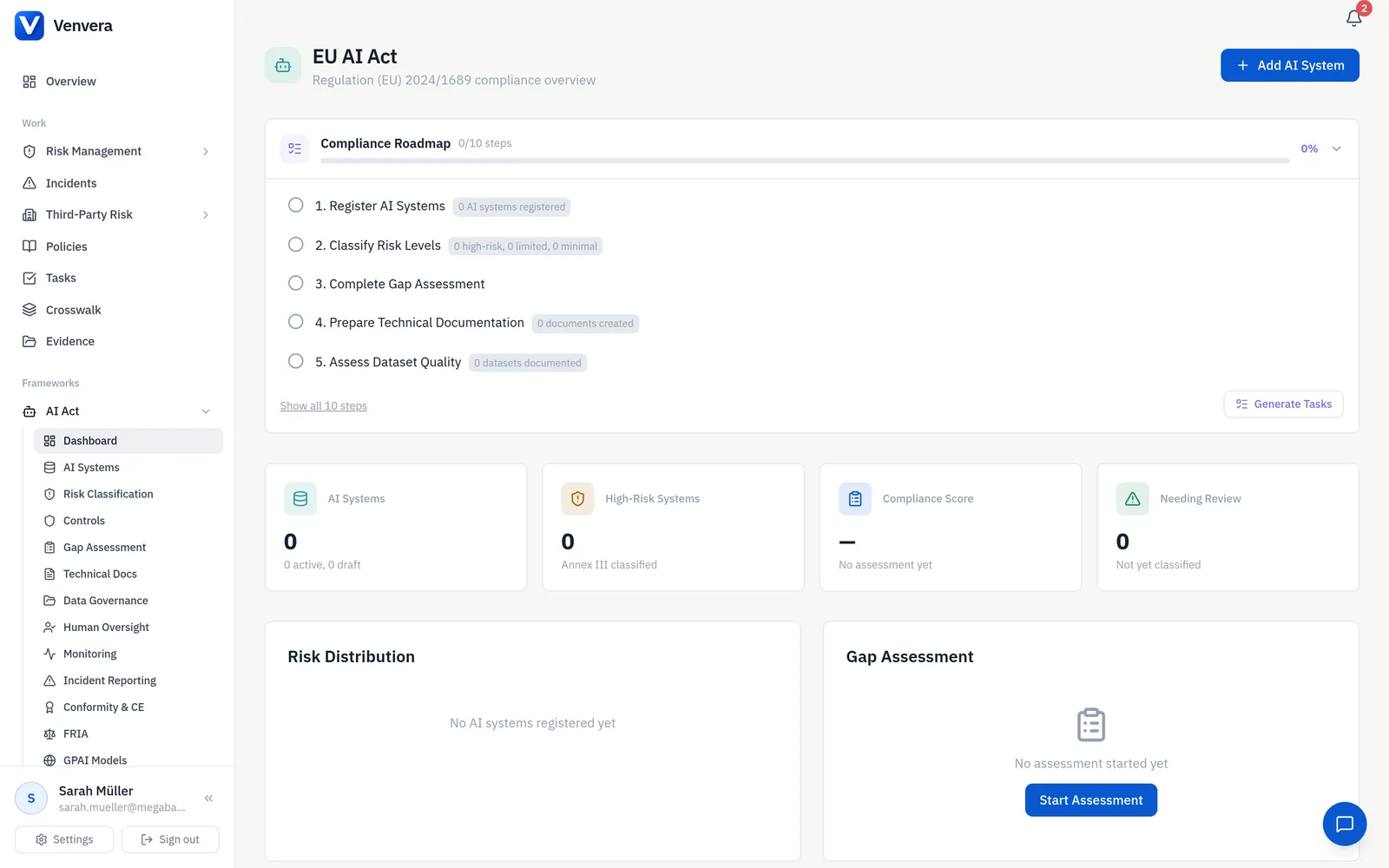
Sort every AI system into the right risk tier in minutes.
The Act sorts every AI system into four tiers - unacceptable (prohibited), high-risk, limited and minimal - and the tier decides your entire workload. Venvera runs a guided classification against the Annex I and Annex III criteria, flags any prohibited practice outright, and records the reasoning and evidence behind each decision. You end up with a defensible, per-system classification you can hand a regulator, not a spreadsheet of guesses.
- Guided classification against Annex I and Annex III criteria
- Prohibited use case screening with automatic flagging
- High-risk determination by sector and use case
- Limited-risk transparency obligations surfaced automatically
- Classification rationale documented with an evidence trail
Clear conformity assessment before your high-risk AI ships.
Every high-risk system needs a conformity assessment before it reaches the market. Venvera structures the work across all six requirement categories - risk management, data governance, technical documentation, record-keeping, transparency and human oversight - and tracks each from gap to evidence. It assembles the Article 11 technical documentation set and prepares the EU Declaration of Conformity, so the file regulators ask for is built as you go, not scrambled together at the deadline.
- All six high-risk requirement categories tracked
- Implementation status per requirement, with evidence attached
- Article 11 technical documentation package assembled for you
- EU Declaration of Conformity prepared from your data
- Post-market monitoring plan documented alongside
Run a fundamental rights impact assessment that holds up.
Article 27 makes deployers of high-risk AI in public services complete a Fundamental Rights Impact Assessment before going live. Venvera gives you structured FRIA templates that score impact on non-discrimination, privacy, data protection, freedom of expression, human dignity and access to essential services - each rated for likelihood and severity, with mitigations tracked to implementation and a submission-ready report at the end.
- Structured assessment template for each fundamental right
- Impact scoring matrix by likelihood and severity
- Affected population identified and documented
- Mitigation measures planned and tracked to implementation
- FRIA report generated for regulatory submission
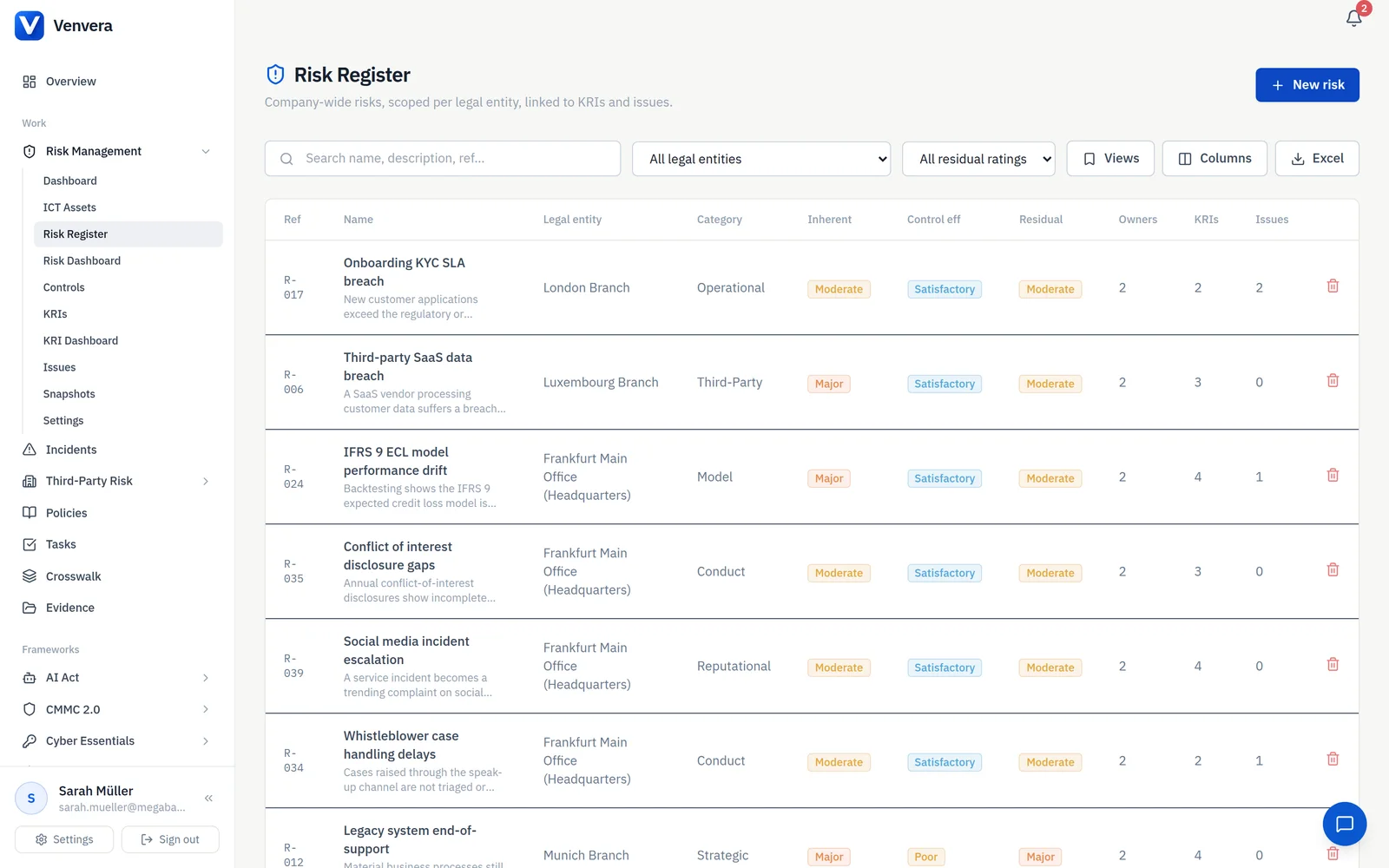
Turn scattered dataset notes into an Article 10 evidence trail.
Article 10 demands that high-risk systems train on data that is relevant, representative and free from errors - and that you can prove it. Venvera holds structured dataset documentation covering sources, collection methods, annotation, bias assessments and quality metrics, and links every dataset to the AI system and version it supports. The result is a complete data lineage a supervisor can follow instead of a folder of loose notes.
- Dataset inventory with source and methodology documented
- Bias assessment templates with mitigation tracking
- Quality metrics: completeness, accuracy, representativeness
- Training, validation and testing sets tracked separately
- Data lineage linking datasets to systems and versions
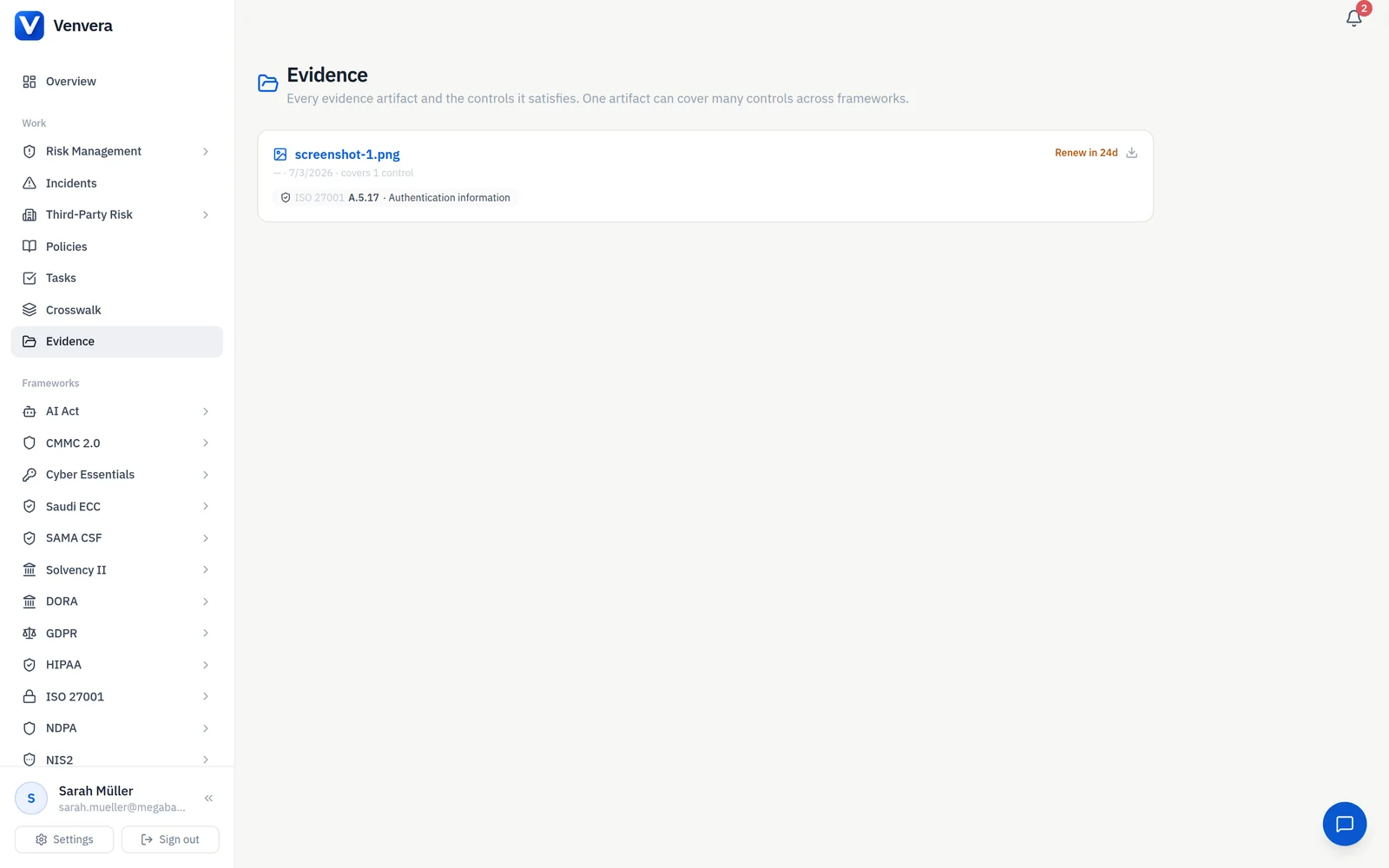
Keep proving your AI is safe long after launch.
Providers of high-risk systems have to run a post-market monitoring system proportionate to the risk - not set it and forget it. Venvera tracks monitoring plans with defined KPIs, performance thresholds, review schedules and escalation triggers. When performance drifts or an incident hits, it links straight to corrective action and regulatory reporting, so you catch the problem before a supervisor does.
- Monitoring plans documented with KPI definitions
- Performance thresholds configured with breach alerting
- Periodic reviews scheduled with automated reminders
- Corrective action workflows triggered by performance issues
- Monitoring evidence collected for regulatory review
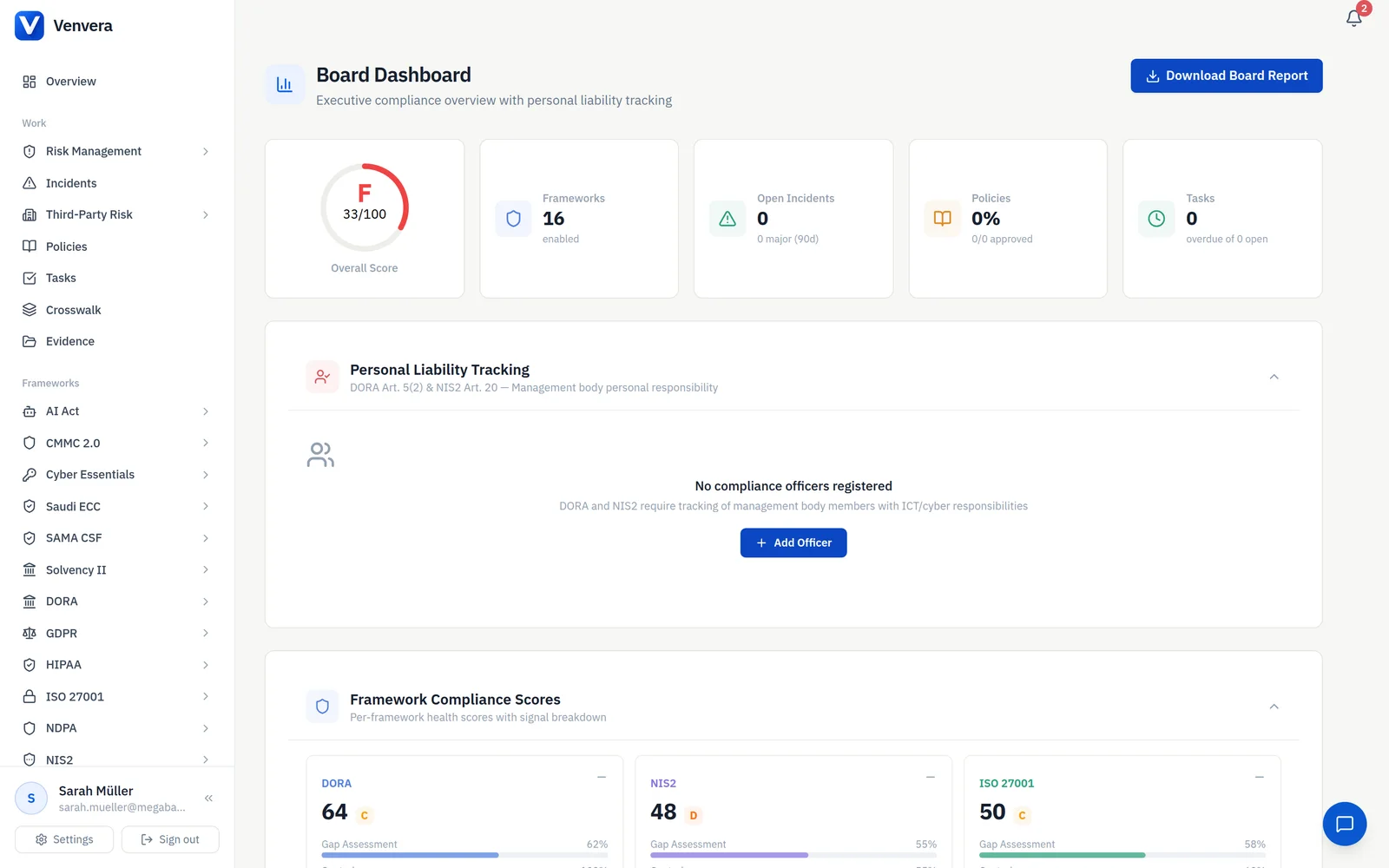
Report a serious AI incident on the clock, not from a blank page.
Providers of high-risk systems must report serious incidents to market surveillance authorities against a deadline. Venvera classifies incidents against the AI Act severity criteria, tracks the reporting clock, and ships pre-formatted report templates. Each incident links back to the specific system, its risk classification and its conformity assessment, so regulators get the full picture and you are never writing the report from scratch.
- AI-specific incident classification criteria
- Serious incident determination workflow
- Pre-formatted templates for market surveillance authorities
- Incidents linked to the AI system and its conformity context
- Corrective action tracked with root cause analysis
The spreadsheet or Venvera.
The EU AI Act, answered.
Know your AI Act exposure before the deadline hits.
Start with a free gap report across your AI systems - 10 minutes, no email to start.
✓ Every paid plan: audit-ready in 90 days, or your money back
10 minutes · no email to start · no credit card · yours to keep