Best
If you are evaluating a Vanta alternative for EU AI Act compliance, the honest framing is this: Vanta has a real AI Act product, and for the governance and classification layer it is strong. The question is whether your obligation stops there. The AI Act does not stop at controls and policies. For a high-risk system it demands a fundamental-rights impact assessment, a technical file to a defined structure, a conformity assessment, and, if you touch general-purpose AI, a separate set of duties. This guide is for the AI governance lead, the compliance manager, or the CISO who has to take a real AI system all the way to conformity, not just map controls to it.
Claims are classified verified (in the vendor's documentation or a product we operate), vendor-stated, or flagged. Vanta's AI Act capabilities are quoted from vanta.com as of 20 July 2026; re-check before relying on any line. The AI Act's high-risk timeline has been subject to the EU's simplification proposals, so treat specific dates as live and confirm them against our high-risk deadline guide.
Short answer
- Vanta is a strong fit for the governance layer: scoping which AI systems are in scope, classifying them by role and risk, and running a large control and policy set with continuous and model monitoring, especially mapped alongside ISO 42001 and the NIST AI RMF.
- Venvera is the better fit if you have to reach conformity on a high-risk system: the fundamental-rights impact assessment, the technical documentation, the conformity-assessment path, general-purpose AI duties and human oversight, covered natively, EU-hosted, at published pricing.
- Match the tool to your depth. Governance and classification, Vanta is excellent. High-risk conformity end to end, weigh the deeper obligations below.
What the EU AI Act actually requires
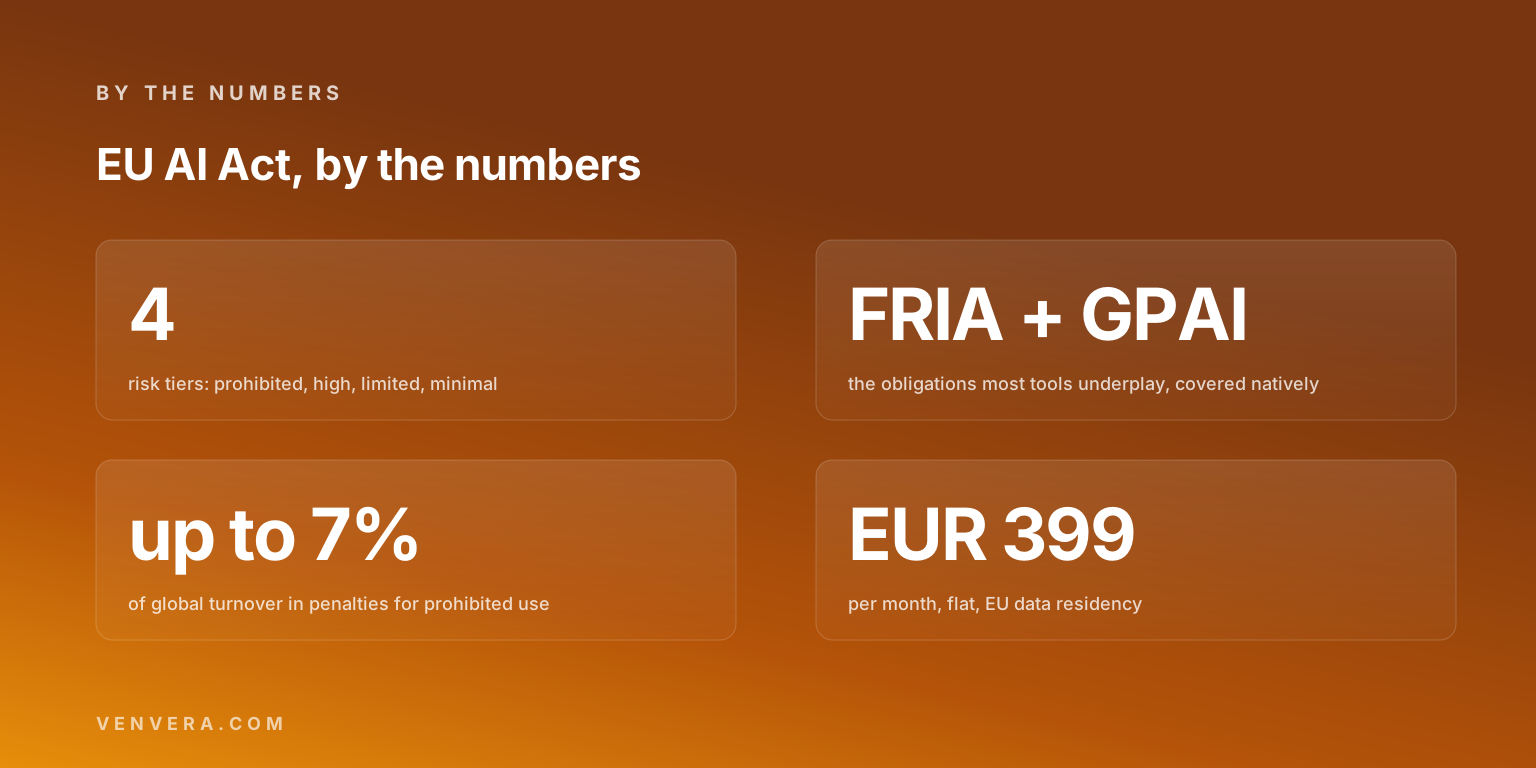
The AI Act (Regulation (EU) 2024/1689) is risk-tiered, and your obligations depend entirely on which tier your system falls into.
- Prohibited practices (unacceptable risk) are banned outright.
- High-risk systems (the Annex III use cases and certain product-safety cases) carry the heavy obligations: a risk-management system, data governance, technical documentation, record-keeping, transparency, human oversight, and accuracy, robustness and cybersecurity, plus a conformity assessment and registration before the system goes to market.
- Limited-risk systems carry transparency duties, for example telling users they are interacting with AI.
- Minimal-risk systems are largely unregulated.
On top of the tiers sit two things a lot of tooling underplays. Deployers of certain high-risk systems must run a fundamental-rights impact assessment (FRIA, Article 27), distinct from a DPIA. And if you build on or provide general-purpose AI, a separate set of Article 53 duties applies, including technical documentation and, for systemic-risk models, more. Getting the classification right is the whole game, because it decides which of these apply.
What Vanta does for the AI Act, honestly
Vanta's AI Act product is capable on the governance layer. From its own documentation (verified on vanta.com, 20 July 2026), it lets you define which AI systems, data and teams fall under the Act, classify systems by role and risk with a readiness framework, and run a large pre-built set of over 150 controls, 16 policies and required artifacts. It provides risk management with tailored scenarios and mapped controls, incident and model monitoring for behaviour and transparency records, AI policy management, and data governance, and it maps to ISO 42001, the NIST AI RMF and CPS 234, with support from an EU-based team.
If your immediate need is to inventory and classify your AI, stand up a control and policy baseline, and monitor models continuously, that is a genuinely strong offering, and one Venvera does not try to out-automate. The difference shows up when a system is classified high-risk and has to reach conformity.
Where the deeper obligations sit
Vanta's own AI Act page notes that auditors expect "a technical file, risk testing results, lifecycle procedures, transparency records, and post-market monitoring plans," but it does not detail its role in each. Those, plus a few others, are exactly the parts a high-risk deployment lives or dies on, and they are where a Vanta alternative for the AI Act has to be deep rather than broad:
- The fundamental-rights impact assessment (Article 27). A FRIA is not a DPIA with a new label; it is a distinct assessment for deployers of certain high-risk systems, and it needs its own workflow.
- The technical documentation. The Act specifies what the technical file must contain. Producing it to that structure is a document-generation job, not a monitoring one.
- The conformity-assessment path. High-risk systems need a conformity assessment before market, and the procedure differs by system. The tool should carry the path, not just the controls.
- General-purpose AI duties. If you provide or build on GPAI, the Article 53 obligations are a separate track that a control checklist does not cover.
- Human oversight (Article 14) as a designed, evidenced mechanism, not only a policy.
How Venvera approaches the AI Act
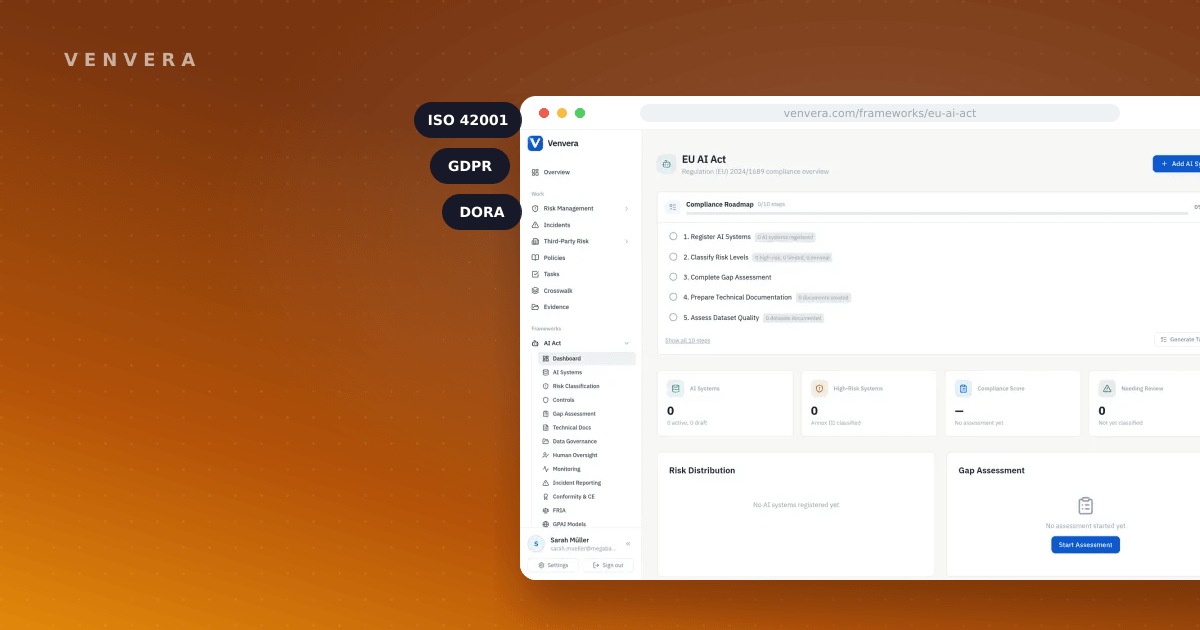
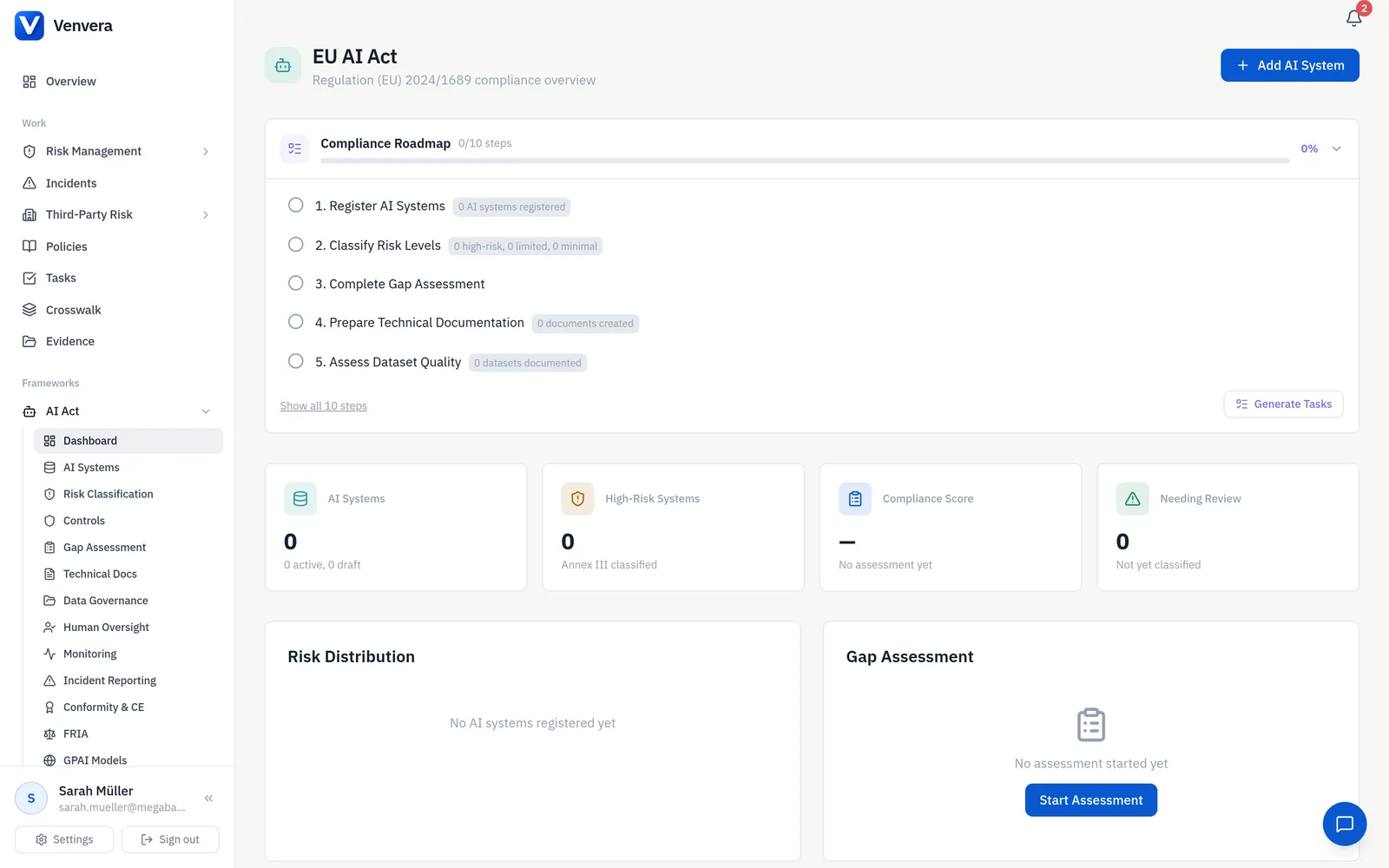
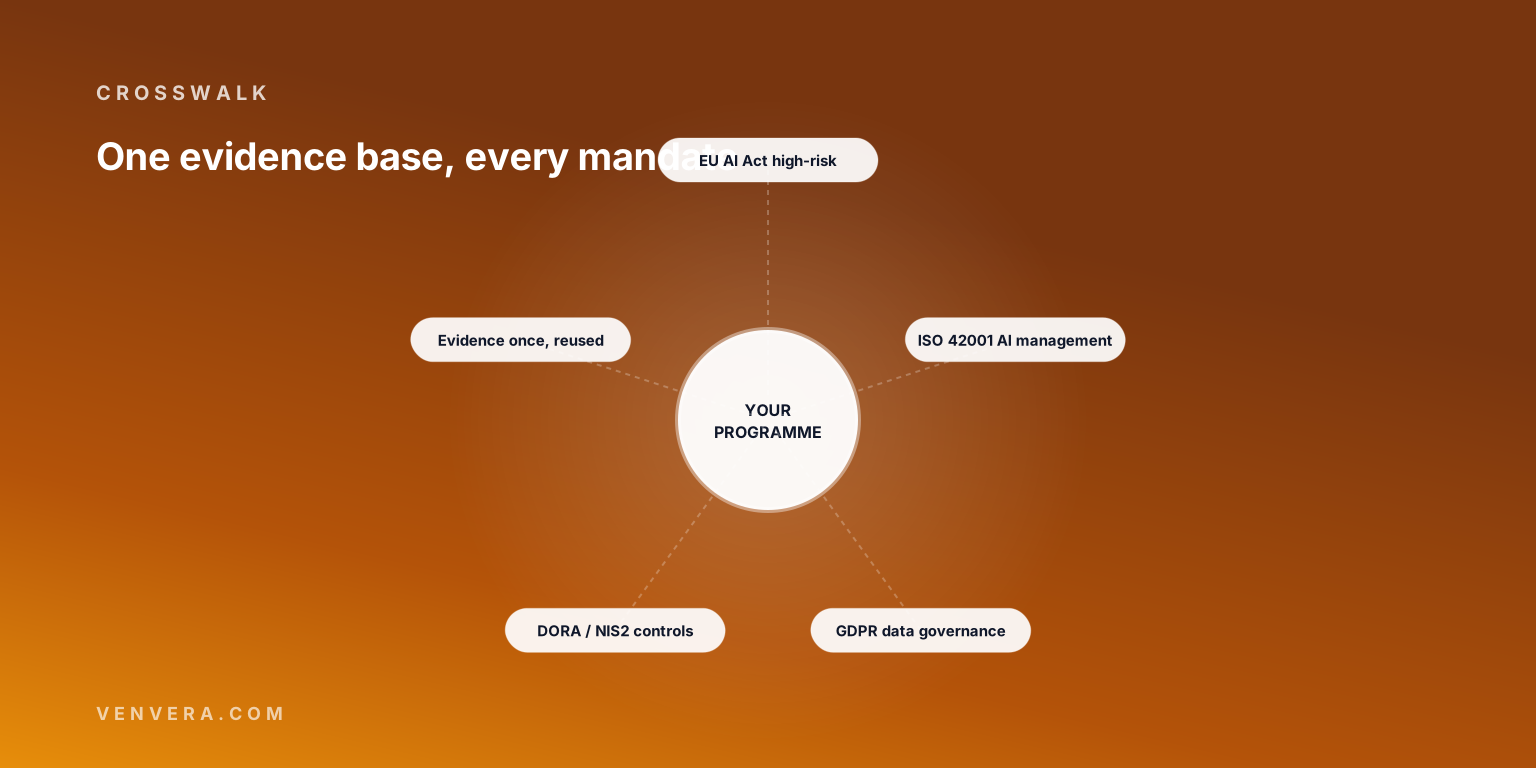
Venvera's EU AI Act module is built around the full obligation set, not just the governance layer. It carries an AI system inventory, role and risk classification, a gap assessment, and then the deep parts directly: the FRIA, the technical documentation, the conformity-assessment path, general-purpose AI duties, data governance, human oversight, incident handling and post-market monitoring. It sits in the same crosswalk as the rest of the platform, so the controls the AI Act shares with ISO 42001 and GDPR reuse the same evidence, and it is EU-hosted with flat published pricing from EUR 399/month.
Honest limits: Venvera does not offer Vanta's breadth of automated model monitoring across a large integration library, nor the same volume of AI automation. If continuous model monitoring and classification at scale is the whole job, Vanta leads. If the job is taking a high-risk system through FRIA, technical file and conformity assessment and defending it, Venvera's depth on those obligations is the reason to look.
Vanta vs Venvera for the EU AI Act, line by line
| AI Act need | Vanta | Venvera |
|---|---|---|
| AI inventory + risk classification | Strong - readiness framework | Native inventory + classification |
| Controls + policy baseline | Strong - 150+ controls, 16 policies | Native control set |
| Model / continuous monitoring | Strong - incident + model monitoring | Post-market monitoring |
| FRIA (Art 27) | Not detailed on the page | Native FRIA workflow |
| Technical file + conformity assessment | Not detailed on the page | Documentation + conformity path |
| General-purpose AI (Art 53) | Not detailed on the page | Native GPAI duties |
| Hosting / pricing | US company; pricing not public | EU-hosted; from EUR 399/mo published |
Vanta rows from vanta.com (verified 20 July 2026); "not detailed on the page" means the capability is absent from Vanta's public AI Act page, not proven absent from the product. Re-verify the row that matters.
How to get a high-risk system to conformity
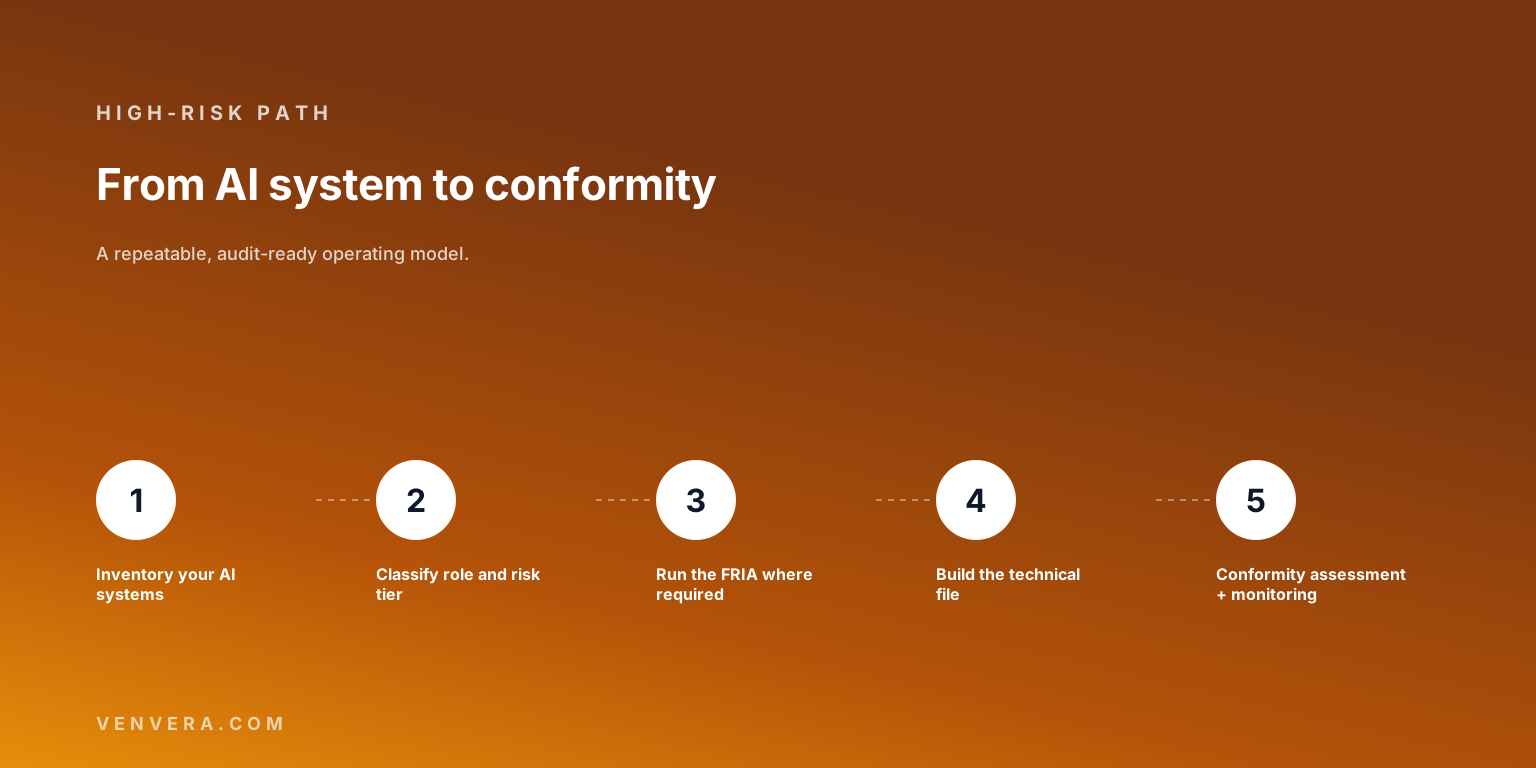
Whatever tool you use, the path from an AI system to a defensible conformity story is the same. This order avoids the most common mistake, building controls before you know the tier.
- Inventory every AI system you build, deploy or embed, with its purpose, users and the data it uses.
- Classify each by role and tier. Provider or deployer, and prohibited, high, limited or minimal risk. This single step decides everything that follows, so get it right before building controls.
- Run the FRIA where required. For deployers of the relevant high-risk systems, the fundamental-rights impact assessment is a gating obligation, not an afterthought.
- Build the technical file to structure. Assemble the documentation the Act specifies, tied to the risk-management system, data governance and testing results.
- Take the conformity-assessment path for the system, then register it before it goes to market, and stand up post-market monitoring.
- Reuse the overlap. ISO 42001 and GDPR share substantial ground with the AI Act; a crosswalk lets one control satisfy several instead of rebuilding it per framework.
Which tool fits which buyer
Choose Vanta if
Your priority is AI governance at scale: inventorying and classifying AI systems, running a broad control and policy baseline, and monitoring models continuously, especially mapped alongside ISO 42001 and the NIST AI RMF, and you are comfortable with a US-operated platform and quote-based pricing.
Choose Venvera if
You have to take a high-risk system to conformity: the FRIA, the technical file, the conformity assessment, general-purpose AI duties and human oversight, done natively, with EU hosting, a crosswalk to ISO 42001 and GDPR, and published pricing.
Go deeper in our Vanta alternative for EU compliance overview, the wider EU AI Act software round-up, the conformity-assessment guide, or ISO 42001 vs the EU AI Act.
Frequently Asked Questions
Does Vanta do EU AI Act compliance?
Yes, on the governance layer. Vanta lets you scope and classify AI systems by role and risk, runs a large pre-built control and policy set, and provides incident and model monitoring, mapped to ISO 42001 and the NIST AI RMF. Its public page is lighter on the FRIA, the technical file, conformity assessment and general-purpose AI duties.
What is the best Vanta alternative for the EU AI Act?
It depends on your depth. For AI governance and classification, Vanta itself is strong. If you must reach conformity on a high-risk system, evaluate alternatives on FRIA, technical documentation, the conformity-assessment path and GPAI specifically; an EU-native platform such as Venvera covers those natively.
What is a FRIA and how is it different from a DPIA?
A fundamental-rights impact assessment, required under Article 27 for deployers of certain high-risk AI systems, assesses the system's impact on fundamental rights. A DPIA under GDPR assesses risks to personal data. They overlap but are distinct, and a high-risk deployment may need both.
Which AI systems are high-risk under the AI Act?
Broadly, systems in the Annex III use cases (such as employment, education, essential services, law enforcement and critical infrastructure) and certain product-safety cases. High-risk classification triggers the full obligation set, so accurate classification is the first and most important step.
When do the EU AI Act obligations apply?
The Act phases in, with prohibited practices, general-purpose AI duties and the high-risk obligations arriving on different dates across 2025 to 2027. The high-risk timeline has been subject to the EU's simplification proposals, so confirm the current date for your case rather than relying on a fixed one.
Primary sources
- Regulation (EU) 2024/1689 (EU AI Act) - the governing text, including the risk tiers, the high-risk obligations (Articles 9 to 15), Article 27 (FRIA) and Article 53 (general-purpose AI). EUR-Lex.
- European Commission - AI Act - the risk-based framework and implementation timeline. digital-strategy.ec.europa.eu.
- Vanta - EU AI Act product page - capabilities quoted above, verified 20 July 2026. vanta.com.
Method note. Vanta capabilities are drawn from vanta.com and classified vendor-stated unless independently confirmed; Venvera capabilities are verified against the product. The AI Act's timeline is subject to change; re-verify dates and the capability that matters before deciding.
Take a high-risk system all the way to conformity.
Venvera handles the EU AI Act natively: system inventory and classification, the FRIA, technical documentation, the conformity-assessment path, general-purpose AI duties and post-market monitoring, EU-hosted, with a crosswalk to ISO 42001 and GDPR. Flat pricing from EUR 399/month. See the EU AI Act module.
By Alexander Sverdlov, CEO and Founder, Venvera. Published 20 July 2026 - Last reviewed 20 July 2026.