
Best
PCI DSS compliance software helps you map, evidence and continuously monitor the controls a card-data environment needs, so an assessment or a self-assessment questionnaire becomes a matter of exporting proof rather than rebuilding it from scratch. This guide is for security and compliance leads at merchants, SaaS companies and payment service providers who touch cardholder data and want the annual cycle to hurt less. We compared seven platforms on framework coverage, crosswalk reuse, data residency, pricing transparency, deployment speed and evidence automation. One rule shaped everything below: no GRC platform here is an Approved Scanning Vendor or a Qualified Security Assessor, so we say plainly where the software ends and a separate contract begins. Reviewed July 2026 against PCI DSS v4.0.1.
Quick answer
- Best overall for EU teams reusing existing work: Venvera - crosswalks PCI DSS onto ISO 27001, SOC 2 and GDPR evidence, with EU data residency and published flat pricing.
- Best for automation-first startups: Vanta or Drata - deep integration libraries and continuous monitoring, though both are SOC 2-first.
- Best when you need scanning and assessment under one roof: SecurityMetrics - a genuine QSA and ASV, not a multi-framework GRC platform.
Why it matters in 2026: PCI DSS v4.0.1 is now in force
The transition period ended on 31 March 2025, so PCI DSS v4.0.1 and its future-dated requirements are now mandatory rather than best practice. The two that catch e-commerce teams off guard are Requirement 6.4.3, which requires you to manage and authorise every payment-page script running in the customer's browser, and Requirement 11.6.1, which requires a change-and-tamper detection mechanism on those pages. Both demand ongoing evidence, not a one-time checkbox, which is exactly the kind of recurring proof that compliance software is built to collect. Add the expanded authentication, logging and risk-analysis expectations across the twelve requirements and the manual spreadsheet approach stops scaling. Software matters in 2026 because the standard now assumes continuous control, and the assessor will ask you to show it.
How we picked
We scored each platform against six weighted criteria:
- Framework coverage (25%) - depth of PCI DSS mapping and the other frameworks it supports.
- Crosswalk reuse (20%) - how much ISO 27001, SOC 2 or GDPR work carries over to PCI DSS.
- Data residency (15%) - where evidence and personal data are stored and processed.
- Pricing transparency (15%) - whether standard pricing is published.
- Deployment speed (15%) - time to a usable, populated control set.
- Evidence automation (10%) - integrations that collect proof without manual upload.
"Verified" means confirmed in vendor documentation or the product we operate; "vendor-stated" means claimed by the vendor but not independently confirmed. Facts were checked on 20 July 2026.

PCI DSS compliance software at a glance
| Platform | Best for | Data residency | Pricing |
|---|---|---|---|
| Venvera | EU teams reusing ISO/SOC 2/GDPR work | EU | From EUR 399/mo |
| Vanta | Automation-first startups | US-based | Not public |
| Drata | Continuous monitoring | US-based | Not public |
| Sprinto | Multi-framework breadth | Not stated | Not public |
| Secureframe | SOC 2/ISO-first teams adding PCI | US-based | Not public |
| Thoropass | Software plus in-house audit | US-focused | Not public |
| SecurityMetrics | Scanning and assessment in one | US-based | Not public |
1. Venvera
Overview
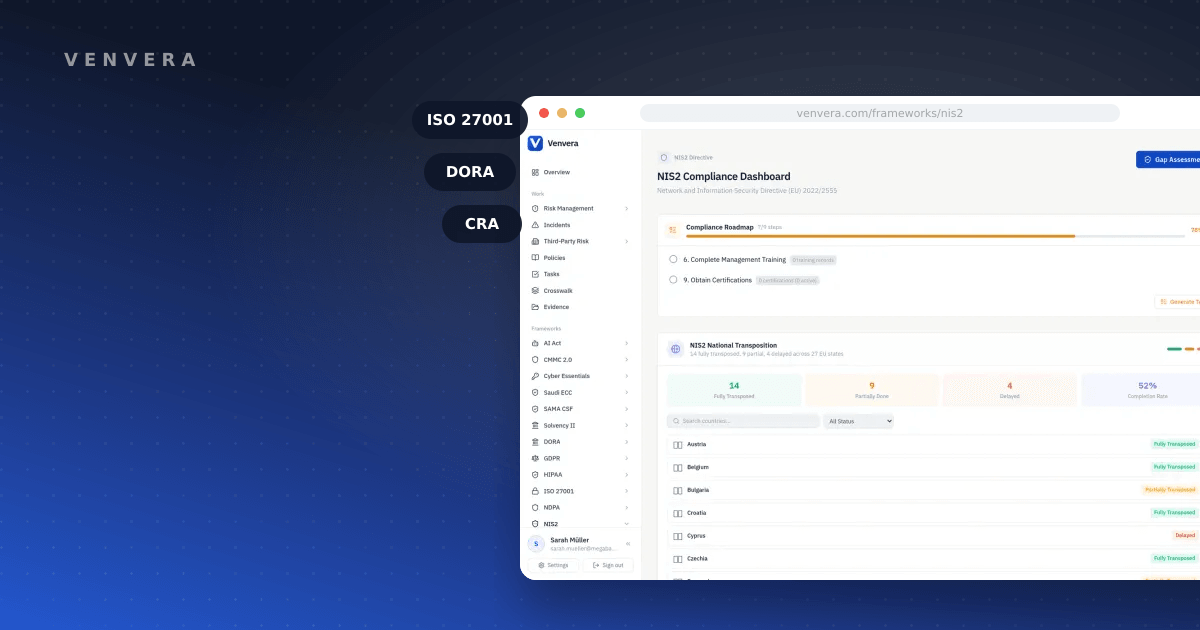
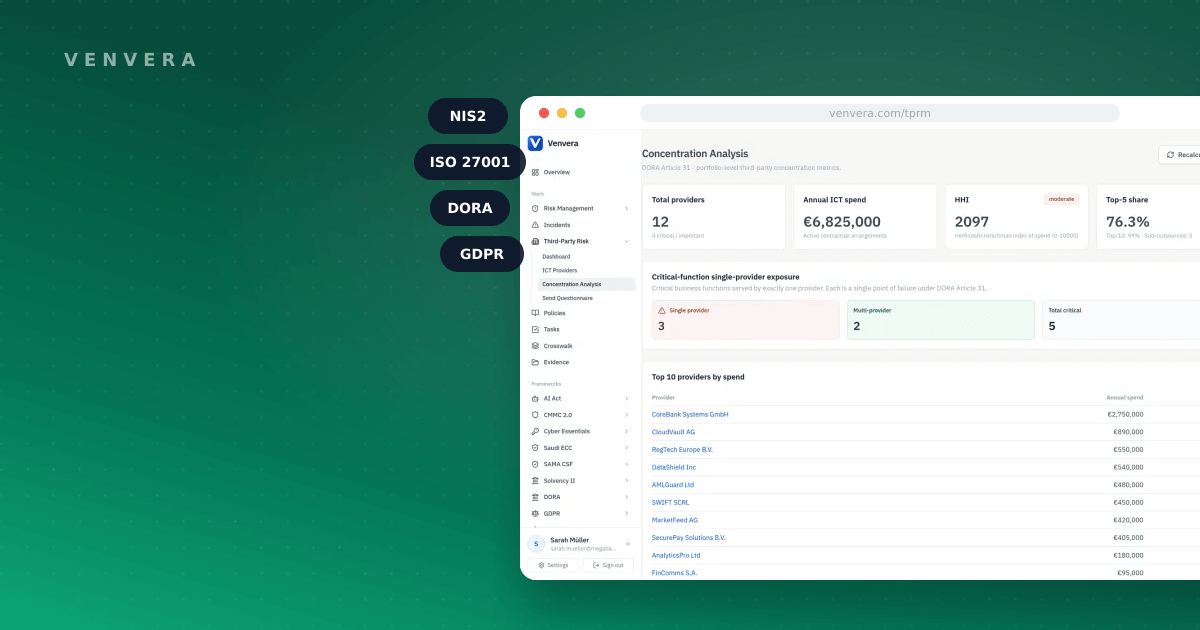
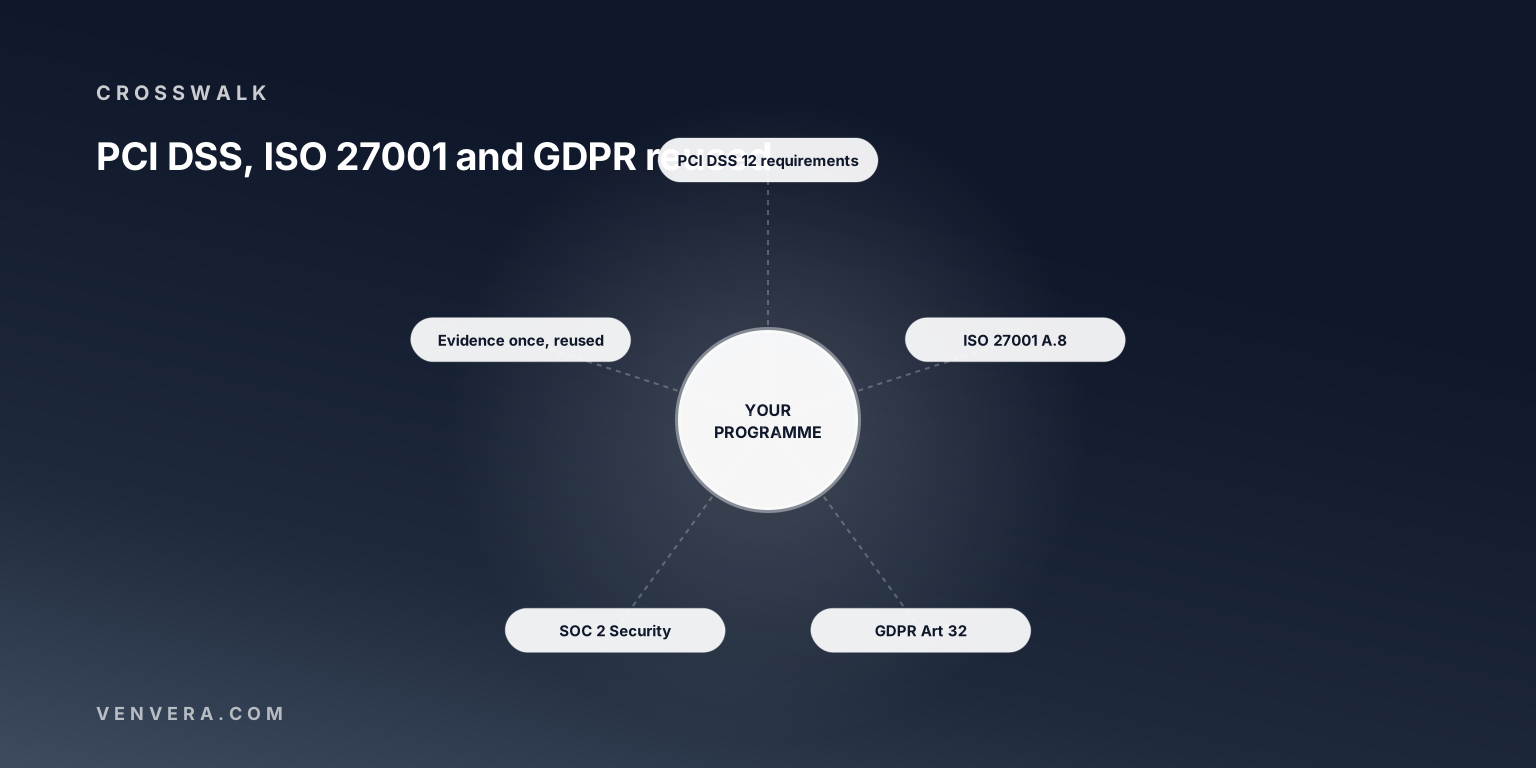
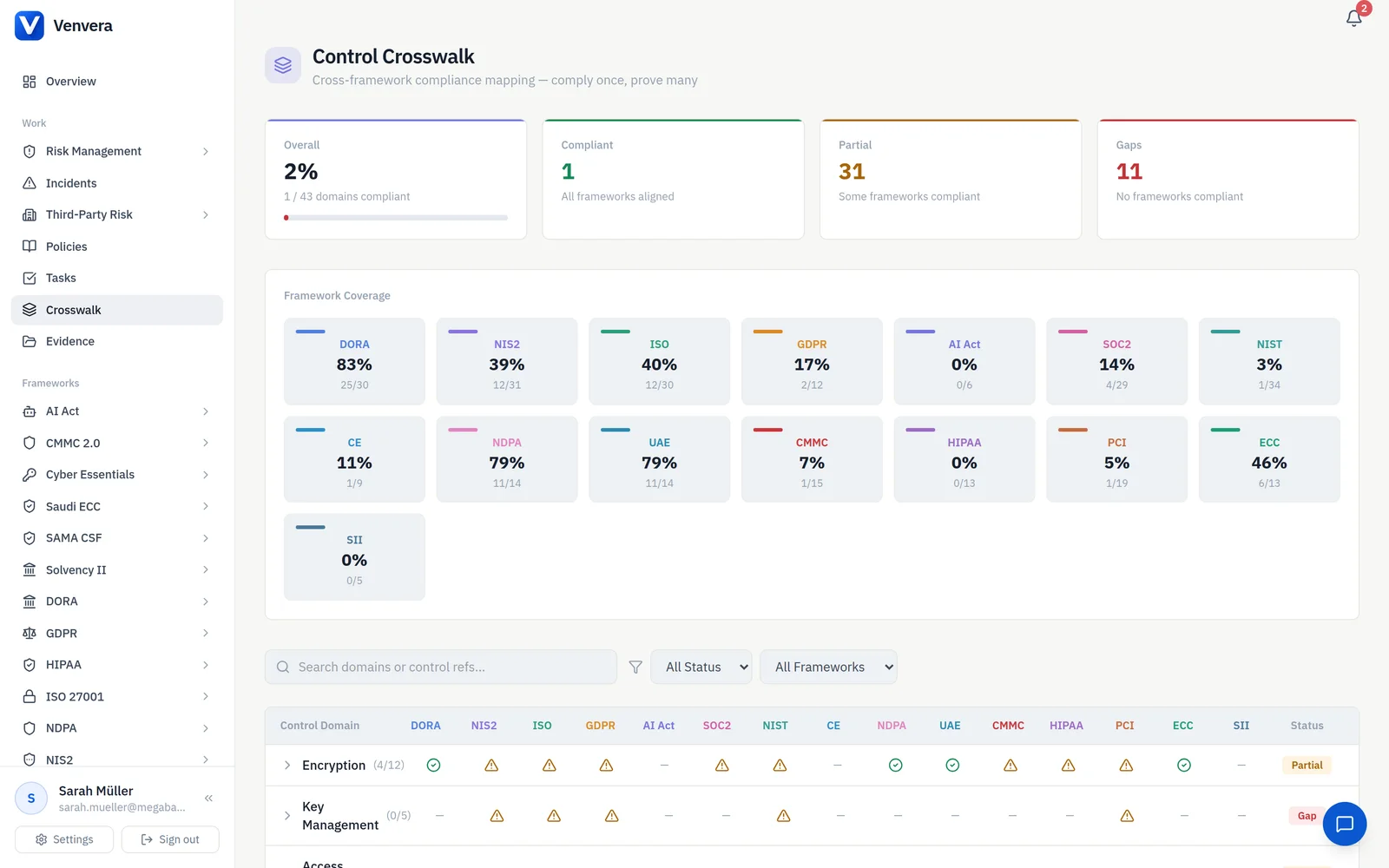
Venvera is an EU-based compliance-governance platform built to organise and evidence controls across many frameworks as peers, rather than treating one as the anchor. Its PCI DSS module maps the twelve requirements to a control set that reuses work you have already done for ISO 27001, SOC 2 or GDPR, so a control satisfied once is evidenced everywhere it applies. Data and evidence stay in the EU, and pricing is published rather than quoted per seat. Venvera is honest about its boundary: it helps you reach and maintain a defensible PCI DSS posture, but it is not an Approved Scanning Vendor or a Qualified Security Assessor, so ASV scans and any Report on Compliance are still separate contracts.
Strengths
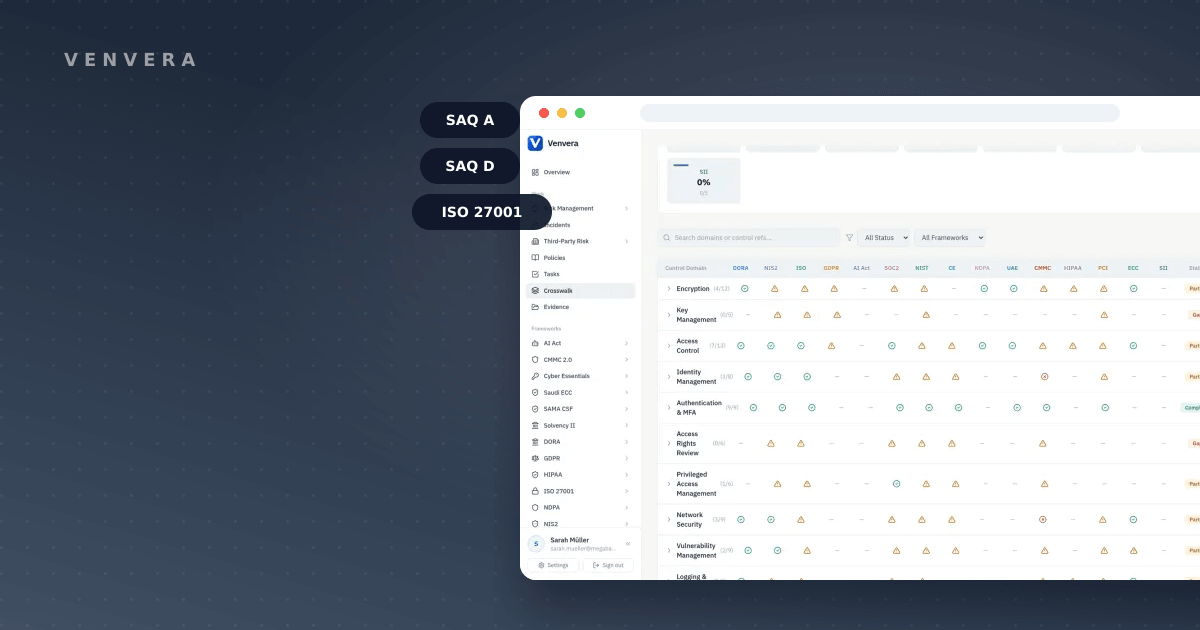
- Verified: crosswalk engine reuses ISO 27001, SOC 2 and GDPR evidence against PCI DSS controls, reducing duplicate work.
- Verified: EU data residency for evidence and personal data.
- Verified: published flat pricing with no per-user fees.
- Verified: every framework treated as a peer, so PCI DSS is not bolted onto a SOC 2-first model.
Cons
- Smaller and younger than the US incumbents.
- Narrower integration catalogue than the automation-first platforms.
- No automation-first SOC 2 monitoring engine.
- Not an ASV or QSA - you still contract scanning and assessment separately, as with every platform here.
Pricing
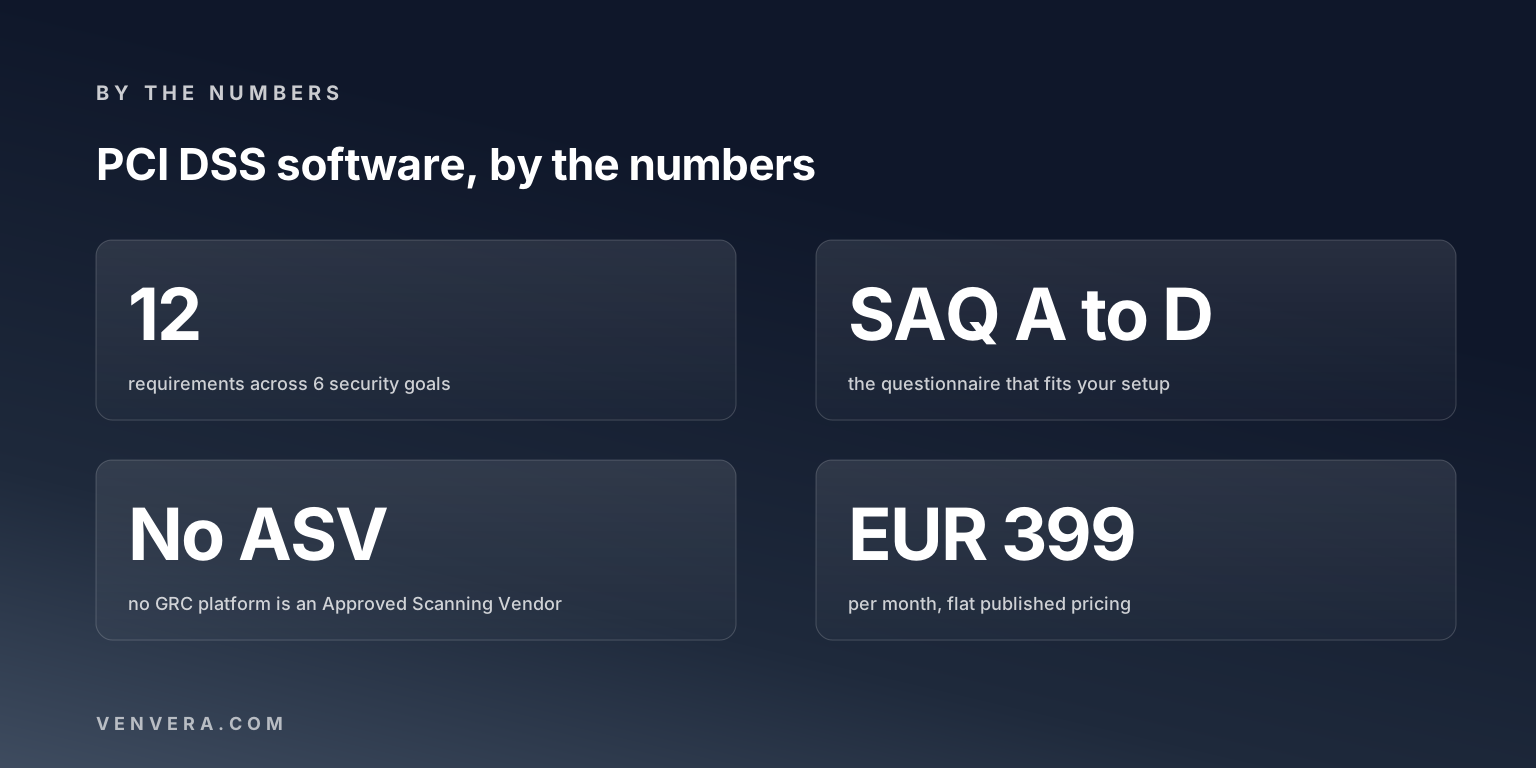
From EUR 399/month (Basic), EUR 899/month (Professional); published, flat, no per-user fees.
Best for
EU merchants and SaaS companies that already hold or are pursuing ISO 27001, SOC 2 or GDPR and want PCI DSS to reuse that evidence rather than start over, with data kept in the EU and pricing they can see before a sales call.
2. Vanta
Overview
Vanta is an automation-first compliance platform with PCI DSS support and one of the largest integration libraries in the category. It leans on connectors to cloud, identity and endpoint tools to collect evidence continuously, which suits fast-moving teams that live in a modern SaaS stack.
Strengths
- Vendor-stated: broad integration library for automated evidence collection.
- Vendor-stated: PCI DSS support alongside a wide multi-framework catalogue.
- Verified: established brand with a large customer base.
Cons
- SOC 2-first heritage, so the PCI DSS-specific depth is lighter than a PCI specialist.
- US-based, which matters for EU data-residency requirements.
- Not an ASV, so scanning is a separate contract.
- Pricing is not public.
Pricing
Not public.
Best for
Automation-first startups with a heavily integrated cloud stack that want continuous evidence collection across several frameworks at once.
3. Drata
Overview
Drata is an automation-first GRC platform with PCI DSS support and a strong emphasis on continuous monitoring. It automates control checks and evidence gathering on a recurring basis, which fits teams that want an always-on view of their posture rather than a point-in-time snapshot.
Strengths
- Vendor-stated: continuous monitoring of controls and evidence.
- Vendor-stated: PCI DSS within a broad multi-framework GRC offering.
- Verified: mature integration ecosystem.
Cons
- Audit-automation focus, so PCI-specific advisory depth is lighter.
- US-based, a consideration for EU data residency.
- Not an ASV, so vulnerability scanning is contracted separately.
- Pricing is not public.
Pricing
Not public.
Best for
Teams that value continuous monitoring and want their PCI DSS controls checked automatically alongside other frameworks.
4. Sprinto
Overview
Sprinto is an automation-first compliance platform covering multiple frameworks including PCI DSS. It is aimed at growing companies that want to stand up several certifications in parallel with a guided, workflow-driven approach.
Strengths
- Vendor-stated: multi-framework coverage including PCI DSS.
- Vendor-stated: automation-first workflows for evidence collection.
- Vendor-stated: guided onboarding aimed at faster time to readiness.
Cons
- Breadth is prioritised over deep PCI DSS specialisation.
- Pricing is opaque.
- Not an ASV, so scanning is a separate contract.
Pricing
Not public.
Best for
Companies pursuing several frameworks at once that want one automation-first tool to coordinate the effort.
5. Secureframe
Overview
Secureframe is an automation-first GRC platform with PCI DSS support among its frameworks. Like its closest peers it collects evidence through integrations and guides teams through a structured readiness process.
Strengths
- Vendor-stated: automated evidence collection via integrations.
- Vendor-stated: PCI DSS support within a multi-framework catalogue.
- Vendor-stated: guided remediation workflows.
Cons
- SOC 2 and ISO-first heritage, so PCI depth is lighter than a specialist.
- US-based, relevant to EU data residency.
- Not an ASV, so scanning is contracted separately.
- Pricing is not public.
Pricing
Not public.
Best for
Teams already leaning toward SOC 2 or ISO 27001 that want to add PCI DSS inside the same automation-first tool.
6. Thoropass
Overview
Thoropass pairs compliance software with in-house audit capability across multiple frameworks including PCI. Bundling the platform and the audit relationship can shorten the handoff between readiness and assessment for teams that want a single vendor to manage both sides.
Strengths
- Vendor-stated: compliance software combined with in-house audit services.
- Vendor-stated: multi-framework coverage including PCI.
- Vendor-stated: a single relationship spanning readiness and audit.
Cons
- US-focused, a consideration for EU-based teams.
- Pricing is opaque.
- The bundled model suits teams that want one vendor, less so those keeping software and audit separate.
Pricing
Not public.
Best for
US-based teams that prefer to buy software and audit from a single vendor to reduce coordination overhead.
7. SecurityMetrics
Overview
SecurityMetrics is a PCI specialist and, unlike every other platform in this guide, a genuine Qualified Security Assessor and Approved Scanning Vendor. That is a real distinction: it can perform the ASV vulnerability scanning and the QSA assessment that GRC platforms cannot, so a single vendor can take you from scanning through to a signed assessment.
Strengths
- Verified: a QSA and an ASV, so it can both scan and assess.
- Verified: deep PCI DSS specialisation.
- Verified: scanning and assessment available from one provider.
Cons
- A PCI specialist rather than a multi-framework GRC platform, so it is a narrower fit if you also need ISO 27001, SOC 2 or GDPR in one place.
- US-based, relevant to EU data residency.
- Pricing is not public.
Pricing
Not public.
Best for
Teams whose primary need is PCI DSS and who want the scan and the assessment from the same specialist, rather than a broad governance platform.
How to choose PCI DSS compliance software
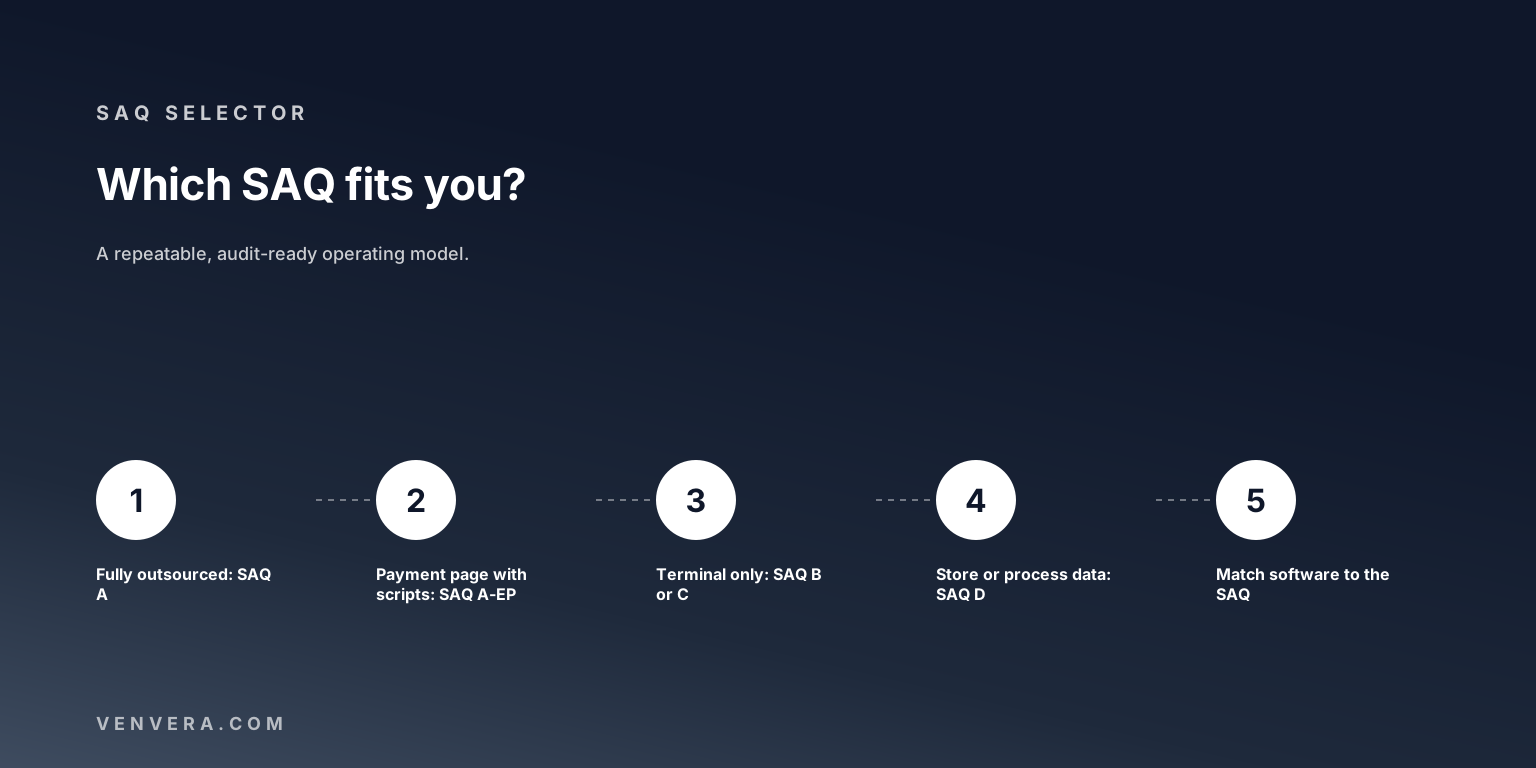
Start by confirming your validation path. Most merchants validate with a Self-Assessment Questionnaire (SAQ); larger merchants and many service providers need a Qualified Security Assessor to produce a Report on Compliance (RoC). Which SAQ applies depends on how you handle card data: SAQ A for fully outsourced e-commerce, SAQ A-EP when your site affects the payment page but does not store data, SAQ B for standalone terminals or imprint machines, SAQ C for payment applications connected to the internet, and SAQ D for everyone else, including service providers. Software can populate any of these, but it does not decide which one you owe.
If you are an EU merchant or SaaS company with existing certifications
Prioritise crosswalk reuse and data residency, because the fastest path to PCI DSS is evidence you already produced for ISO 27001, SOC 2 or GDPR, kept in the EU. Venvera is built around this.
If you are an automation-first startup
Prioritise integration breadth and continuous monitoring, because your evidence lives in cloud and identity tools that connectors can read directly. Vanta and Drata lead here.
If your only mandate is PCI DSS
Prioritise specialisation and, critically, whether the vendor can also scan and assess. A QSA and ASV like SecurityMetrics removes a coordination step that GRC platforms cannot, because ASV scanning is always a separate function.
Whichever you choose, remember the boundary: the quarterly ASV vulnerability scan and any QSA-signed assessment are separate contracts. No platform in this guide, Venvera included, is an ASV or a QSA.
Frequently Asked Questions
How much does PCI DSS compliance software cost?
Most vendors in this category do not publish standard pricing and quote per organisation, so budget for a sales conversation. Venvera is the exception here, with published flat pricing from EUR 399/month (Basic) and EUR 899/month (Professional), no per-user fees. Remember to budget separately for ASV scanning and, if you need one, a QSA assessment, since neither is included in GRC software.
Do I need software or a consultant?
They solve different problems. Software organises controls, collects evidence and keeps your posture current between assessments; a consultant or QSA advises on scope and validates compliance. Many teams use both: software to do the ongoing work and reduce cost, and a QSA when their validation path requires a Report on Compliance. Software alone cannot sign off your compliance.
Can PCI DSS compliance software run my ASV scan?
No. Approved Scanning Vendor vulnerability scanning is a distinct service that only a PCI SSC-approved ASV can perform, and QSA assessment is likewise a separate contract. GRC platforms, Venvera included, help you prepare, evidence and track, but they are not ASVs or QSAs. A specialist like SecurityMetrics is both, which is the genuine exception in this guide.
Which SAQ do I need?
It depends on how you accept card payments. Fully outsourced e-commerce typically uses SAQ A, sites that affect the payment page use SAQ A-EP, standalone terminals use SAQ B, connected payment applications use SAQ C, and everything else, including service providers storing data, uses SAQ D. Your acquiring bank or QSA confirms the correct one; software then helps you complete it.
What changed in PCI DSS v4.0.1?
PCI DSS v4.0.1 is the current standard, with its future-dated requirements mandatory since 31 March 2025. The most disruptive for e-commerce are Requirement 6.4.3 (managing and authorising payment-page scripts) and Requirement 11.6.1 (detecting tampering and changes to those pages), both requiring ongoing evidence. There are also expanded authentication, logging and targeted risk-analysis expectations across the twelve requirements.
Does one platform cover PCI DSS and other frameworks?
Yes, most multi-framework platforms do, and this is where crosswalks pay off. If you already hold ISO 27001 or SOC 2, a platform that reuses that evidence against PCI DSS controls saves duplicate work. Venvera is designed around treating each framework as a peer so a control evidenced once counts everywhere it applies.
Primary sources
- PCI Security Standards Council - the body that publishes and maintains the PCI DSS standard, SAQs and the ASV and QSA programmes. PCI SSC.
- PCI DSS v4.0.1 - the current version of the standard and its requirements, including 6.4.3 and 11.6.1. PCI SSC Document Library.
- PCI SSC Approved Scanning Vendors - the official list of vendors approved to perform ASV scans. ASV Programme.
Method note. Competitor facts are from public vendor documentation as of 20 July 2026 and are classified verified or vendor-stated; pricing is marked "Not public" where a vendor does not publish it. Venvera facts are verified against the product.
See PCI DSS reuse your existing evidence
Venvera maps PCI DSS v4.0.1 onto the ISO 27001, SOC 2 and GDPR work you have already done, with EU data residency and flat pricing from EUR 399/month. Explore the PCI DSS module to see the crosswalk in action.
By Alexander Sverdlov, CEO and Founder, Venvera. Published 20 July 2026 - Last reviewed 20 July 2026.