Best
Searching for Cyber Resilience Act compliance software in 2026 turns up two very different kinds of product wearing the same label, and buying the wrong one is expensive. This guide compares six platforms, explains the split that decides which one fits, and does it before the first hard deadline lands. From 11 September 2026, manufacturers of products with digital elements must report actively exploited vulnerabilities and severe incidents to their national CSIRT and ENISA on a 24-hour / 72-hour / 14-day clock. This is written for the person who owns that obligation: the product security lead, the compliance manager, or the founder of a company that ships hardware or software into the EU.
Quick answer
- Best overall for CRA compliance governance and reporting: Venvera - the 24 essential-requirement controls, the Article 14 reporting clock, and a crosswalk that reuses your NIS2 and ISO 27001 evidence, at published prices.
- Best for SBOM and supplier evidence: Certivo - purpose-built to collect and validate supplier SBOMs into audit-ready CRA technical documentation.
- Best for large application-security teams: ArmorCode - an ASPM platform that maps CRA onto findings and SBOMs across a big engineering estate.
Why 2026 is the year this matters
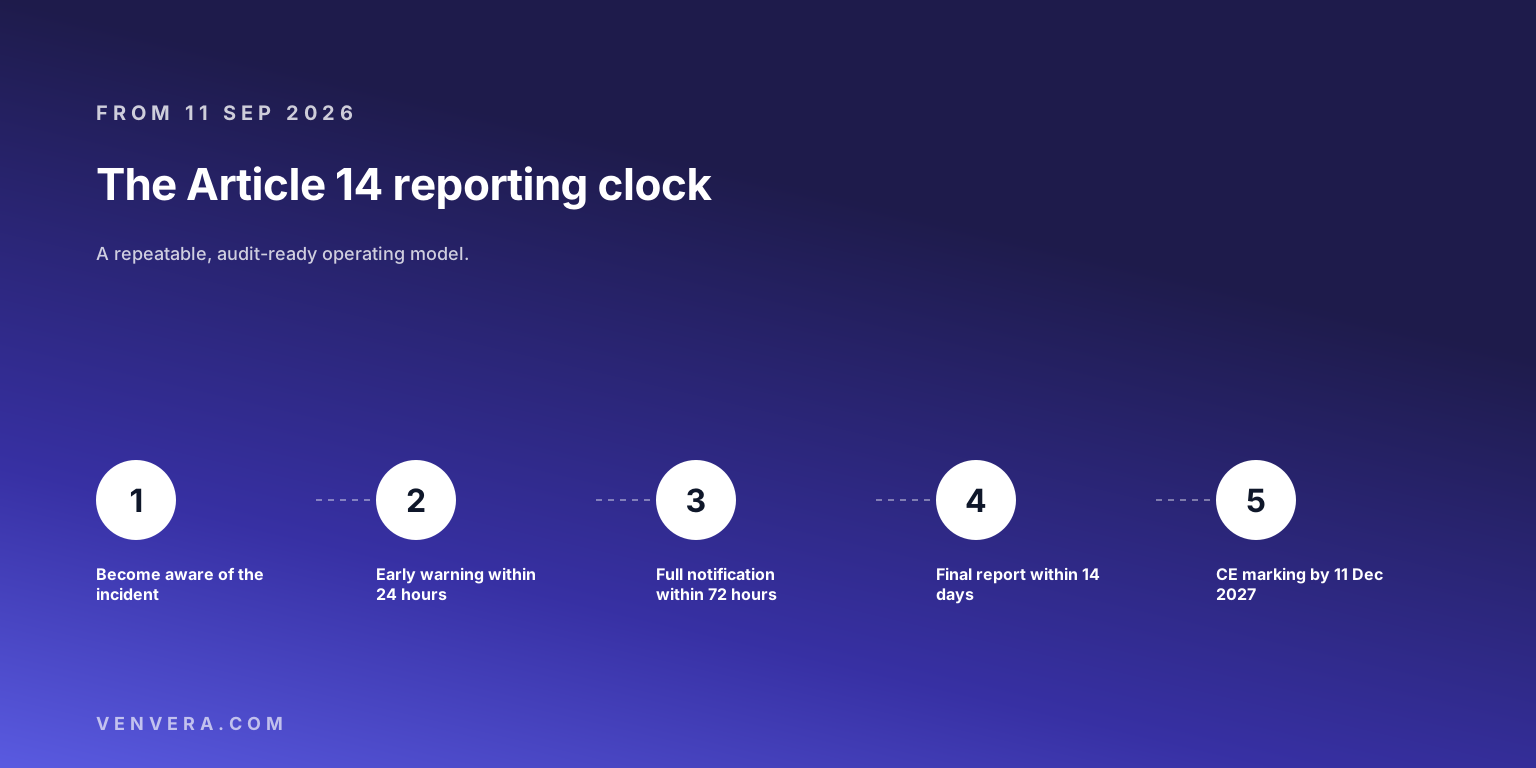
The Cyber Resilience Act (Regulation (EU) 2024/2847) entered into force on 10 December 2024, but its obligations phase in. The date that turns it into a project is 11 September 2026, when the Article 14 reporting duties begin. From that day, a manufacturer that becomes aware of an actively exploited vulnerability in a product with digital elements, or a severe incident affecting its security, must file:
- an early warning within 24 hours of becoming aware,
- a full notification within 72 hours, and
- a final report within 14 days (for an actively exploited vulnerability, once a corrective measure is available) or within one month for a severe incident.
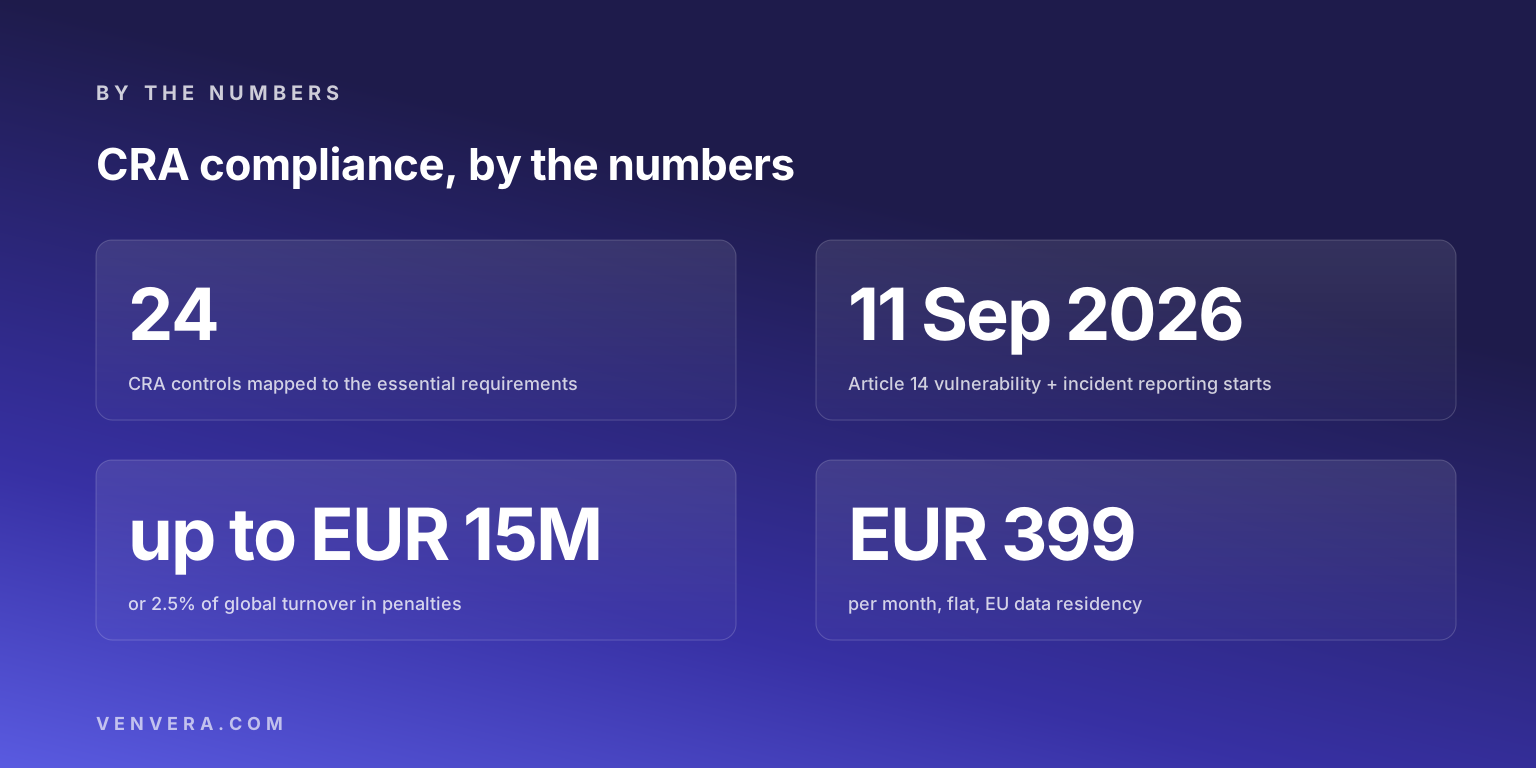
Reports go to the CSIRT designated as coordinator in the manufacturer's main place of establishment and, simultaneously, to ENISA, through the new Single Reporting Platform. The full set of essential requirements, CE marking and conformity assessment then applies from 11 December 2027. Penalties for breaching the essential requirements reach up to EUR 15 million or 2.5% of global annual turnover, whichever is higher. That combination, a near deadline plus large fines, is why "CRA compliance software" became a category people shop for, and why the SERP is still young enough to choose from on the merits. If you are still scoping whether the regulation reaches you, start with our guides on who must comply with the Cyber Resilience Act and the CRA deadlines for 2026 and 2027.
The split that decides which tool you need
Here is the distinction that most listicles miss. CRA compliance has two halves, and almost every product is strong at one of them.
- The technical product-security half. Generating a software bill of materials (SBOM), scanning for and remediating vulnerabilities, secure development, and security testing. This is the home ground of application security posture management (ASPM) and software composition analysis (SCA) tools.
- The compliance-governance half. Mapping the essential requirements to owned, evidenced controls; scoping your economic-operator role (manufacturer, importer, distributor) per product; running the coordinated vulnerability disclosure policy; operating the Article 14 reporting clock; and assembling the conformity-assessment and CE-marking documentation. This is the home ground of GRC and compliance-governance platforms.
You almost certainly need both. An SBOM tool will not prove to a market surveillance authority that your organisation is governed, that your disclosure policy is published, or that your incident was reported inside the window. A governance platform will not scan your source code. The mistake is buying two tools that both do the technical half, or one tool that claims to do everything and does the governance half thinly. Read each product below for which half it owns.
How we picked (methodology)
Each platform was scored against six weighted criteria, checked against vendor documentation and, for Venvera, the product itself, on 20 July 2026.
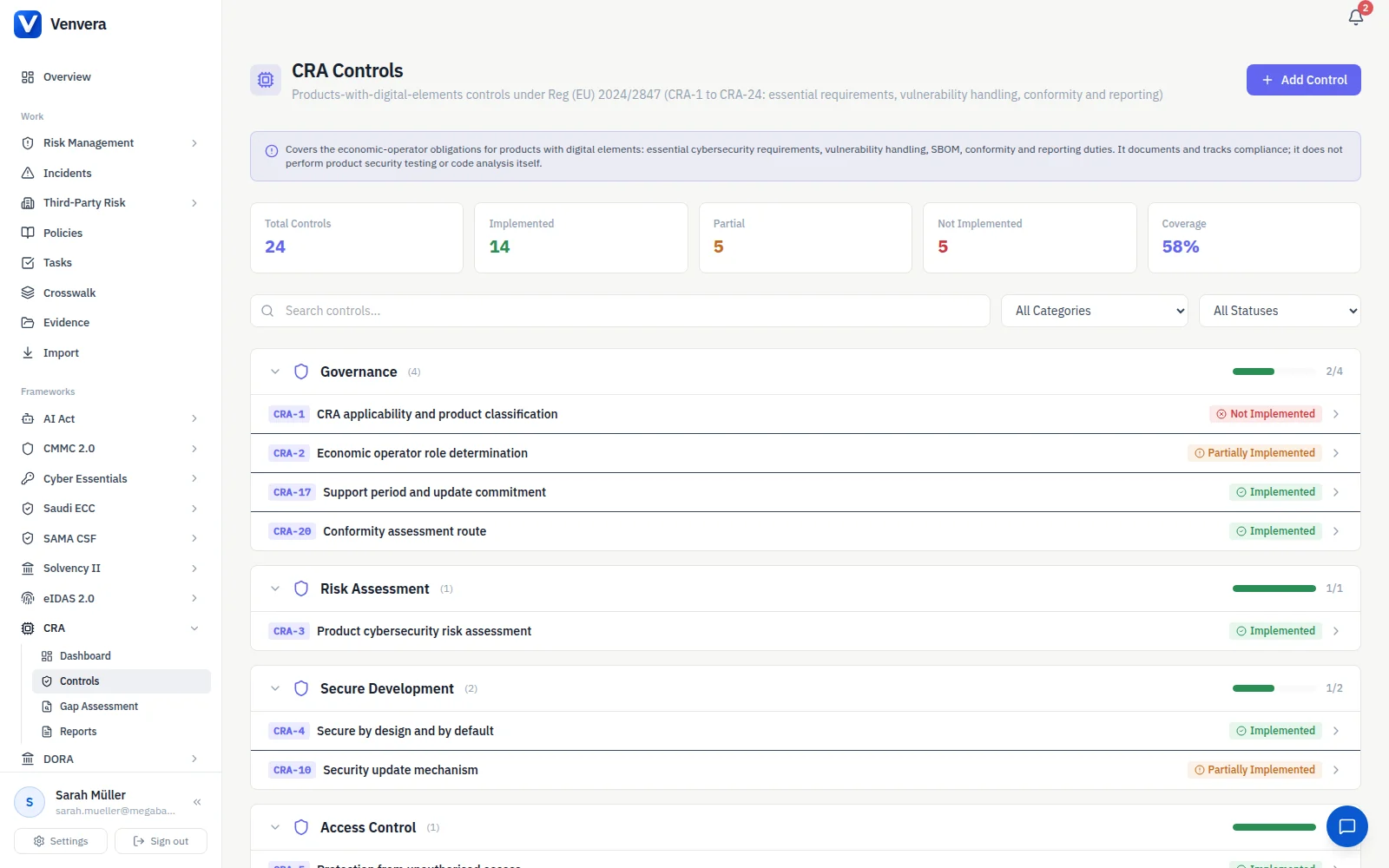
- CRA essential-requirement coverage and control mapping (25%) - how completely the tool maps Annex I essential requirements to owned, evidenced controls.
- Article 14 reporting workflow (20%) - whether the 24h / 72h / 14-day clock is a first-class, time-bound workflow rather than a task.
- SBOM and vulnerability handling (15%) - depth on the technical half.
- Cross-framework reuse (15%) - whether CRA evidence is shared with NIS2, ISO 27001 and DORA instead of re-collected.
- Pricing transparency (15%) - published numbers score higher than "contact sales".
- EU data residency and hosting (10%) - where the compliance data lives.
What "verified" means. Verified = confirmed in vendor documentation or, for Venvera, in the product we operate. Vendor-stated = claimed by the vendor and not independently confirmed. Where a fact could not be substantiated (most third-party pricing), it is marked "Not public" rather than guessed.
CRA compliance software at a glance
| Platform | Half it owns | Article 14 clock | Pricing | Best for |
|---|---|---|---|---|
| Venvera | Governance | Built in | From EUR 399/mo | Governance + reporting + crosswalk |
| Certivo | Technical (SBOM) | Partial | Not public | SBOM + supplier evidence |
| ArmorCode | Technical (ASPM) | Via workflows | Not public | Large AppSec estates |
| Mend.io | Technical (SCA/SBOM) | Partial | Not public | SBOM + vuln remediation |
| Cycode | Technical (ASPM) | Via workflows | Not public | Code-to-cloud security teams |
| Zealience | Governance | Guided | Not public | EU-focused CRA guidance |
1. Venvera
Overview
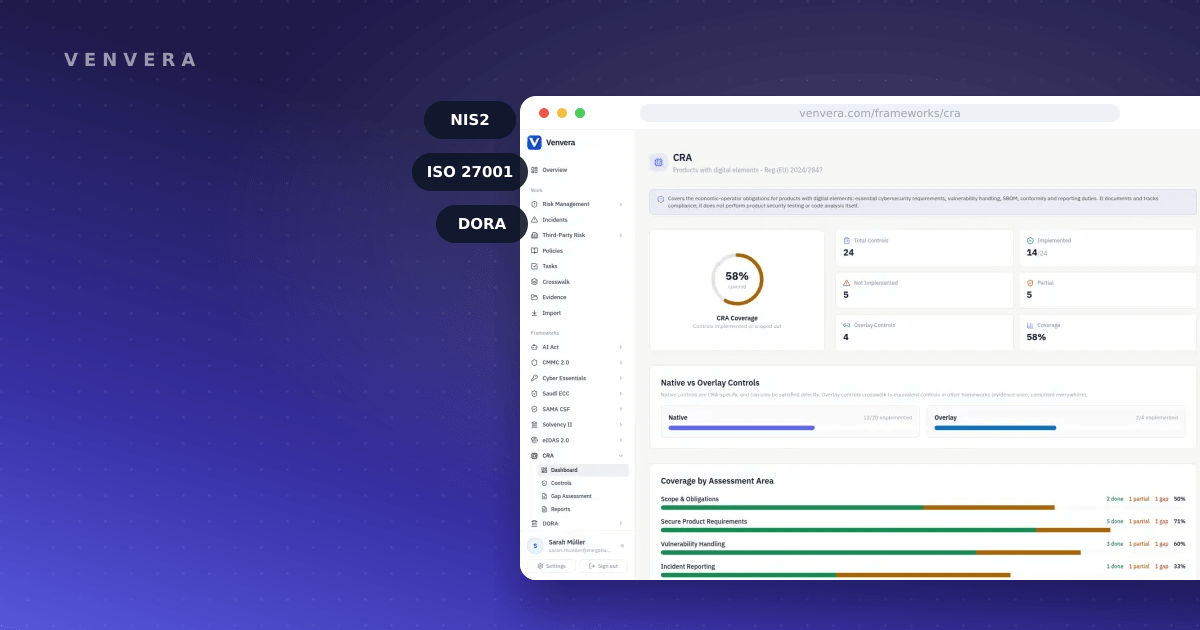
Venvera is an EU-built compliance-governance platform. Its CRA module maps the essential requirements to 24 owned controls across governance, secure development, vulnerability handling, incident response, transparency and third-party areas, scopes your economic-operator role per product, and runs the Article 14 reporting duties on an automated clock. It is the governance half, and it is explicit that it does not replace an SBOM or code-scanning tool.
Strengths
- Article 14 reporting as a live clock (verified) - the 24h / 72h / 14-day duties run as time-bound workflows to the CSIRT and ENISA, not as generic tasks.
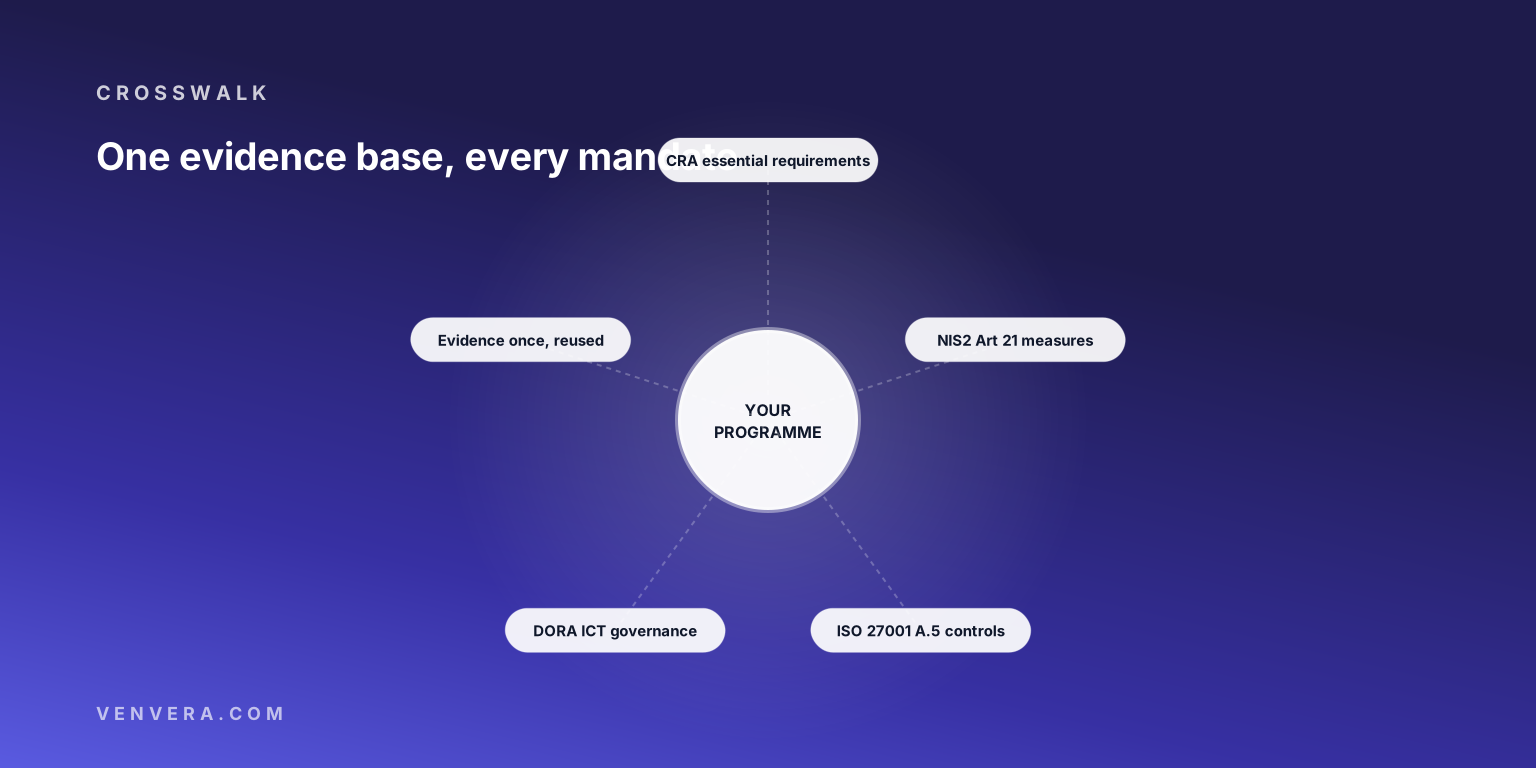
- Cross-framework crosswalk (verified) - CRA controls that genuinely overlap with NIS2, ISO 27001 and DORA reuse the same evidence, so a manufacturer already under those regimes does the shared work once.
- Published pricing and EU data residency (verified) - flat pricing from EUR 399/month, no per-user fees, data hosted in the EU.
- Honest scope boundary (verified) - the product states plainly what it does not do, which holds up better with a market surveillance authority than an all-in-one claim.
Cons
- A smaller, younger company than the established security vendors, with a newer CRA module.
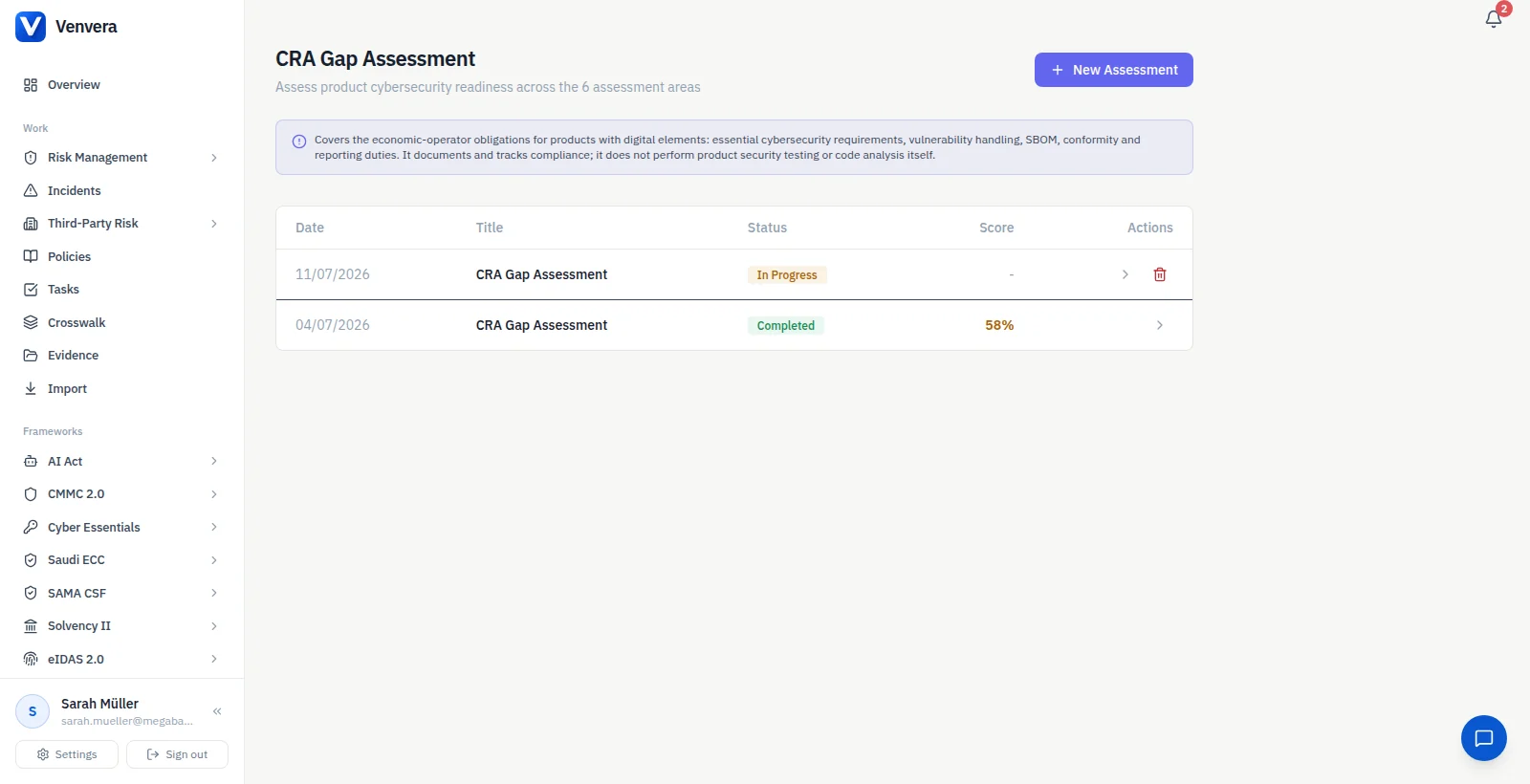
- It is a governance layer: it does not generate SBOMs, scan source code or run automated vulnerability detection. For the technical half you pair it with an SBOM/AppSec tool.
- The integration catalogue is narrower than the large ASPM platforms, and there is no US-hosted option.
Pricing
From EUR 399/month (Basic), EUR 899/month (Professional); annual billing is lower. Enterprise is custom. Published, flat, no per-user fees.
Best for
Manufacturers and importers who need the compliance-governance half done properly, especially those already carrying NIS2, ISO 27001 or DORA who want to reuse that evidence.
2. Certivo
Overview
Certivo is a CRA-focused platform built around the SBOM and supplier-evidence problem. It collects supplier software bills of materials, validates them against the essential requirements, and assembles audit-ready technical documentation.
Strengths
- Purpose-built for CRA SBOM collection and supplier cybersecurity declarations (vendor-stated).
- Turns supplier evidence into technical documentation aligned to the essential requirements (vendor-stated).
Cons
- Focused on SBOM and supplier evidence; it is not a broad multi-framework GRC platform, so if you also carry NIS2, ISO 27001 or DORA you will run it alongside a separate governance tool.
- Pricing is not published.
Pricing
Not public.
Best for
Manufacturers whose main CRA pain is collecting and validating SBOMs from a supply chain of component vendors.
3. ArmorCode
Overview
ArmorCode is an application security posture management (ASPM) platform. It aggregates findings from across the software development lifecycle, manages SBOMs and vulnerabilities, and maps that work to frameworks including the CRA.
Strengths
- Strong on the technical half: consolidating vulnerability findings and SBOMs across a large engineering estate (verified as ASPM capability).
- CRA is one of many frameworks it maps onto existing AppSec data (vendor-stated).
Cons
- An enterprise ASPM platform: the strength is broad application-security management, more than a smaller manufacturer needs, and the compliance-governance and conformity-assessment side is not its centre of gravity.
- US-headquartered; pricing is enterprise and not published.
Pricing
Not public.
Best for
Large software organisations that already need ASPM and want CRA mapped onto the AppSec work they are doing anyway.
4. Mend.io
Overview
Mend.io is rooted in software composition analysis. For the CRA it emphasises generating CRA-grade SBOMs, automating vulnerability remediation, and producing audit-ready evidence on the technical side.
Strengths
- Mature SCA and SBOM generation with automated remediation workflows (verified as SCA capability).
- Directly addresses the vulnerability-handling essential requirement on the technical half (vendor-stated for CRA framing).
Cons
- CRA is framed on top of an application-security toolchain, so the compliance-governance, economic-operator scoping and conformity-assessment side is lighter.
- US-based; pricing is not published.
Pricing
Not public.
Best for
Engineering teams that want SBOM generation and vulnerability remediation as the core, with CRA framing on top.
5. Cycode
Overview
Cycode is a complete ASPM platform aimed at security and engineering teams, covering code-to-cloud visibility, SBOMs and vulnerability management, with CRA mapped onto that posture.
Strengths
- Broad code-to-cloud application-security coverage (verified as ASPM capability).
- Useful for the technical half where engineering owns the CRA response (vendor-stated for CRA framing).
Cons
- CRA is mapped onto ASPM rather than run as a compliance-governance workflow with role scoping and reporting duties.
- Aimed at security and engineering teams rather than a compliance or board audience; pricing is not published.
Pricing
Not public.
Best for
Security teams that already run ASPM and want CRA folded into it.
6. Zealience
Overview
Zealience is an EU-focused player publishing CRA guidance, including detailed Article 14 reporting material, with tooling aimed at the compliance-governance half.
Strengths
- EU-focused and CRA-native, with genuinely useful public guidance on the Article 14 timeline (verified from published resources).
- Aimed at the governance half rather than pure AppSec (vendor-stated).
Cons
- A younger, smaller vendor with a shorter track record than the established platforms.
- Narrower multi-framework reuse than a full GRC crosswalk; pricing is not published.
Pricing
Not public.
Best for
EU manufacturers who want CRA-native governance guidance and are comfortable with a newer vendor.
How to choose CRA compliance software
Start from the split, then your role and your existing obligations.
If your pain is the supply chain and SBOMs
If most of your product is assembled from third-party and open-source components, the SBOM tools earn their place: Certivo for supplier evidence, Mend.io or Cycode where engineering owns the response. Pair one with a governance layer for the reporting and documentation duties.
If you already carry NIS2, ISO 27001 or DORA
Prioritise the crosswalk. A large share of CRA governance controls overlap with those regimes, and re-collecting the same evidence per framework is wasted work. This is where Venvera's one-evidence-base approach removes the most effort.
If the 11 September 2026 clock is what keeps you up
Weight the Article 14 reporting workflow heavily. Ask each vendor to show you the 24h / 72h / 14-day duties as a live, owned workflow to the CSIRT and ENISA, not a reminder. A missed early-warning window is the most visible way to fail the CRA in 2026.
If pricing transparency matters
Most of this market is "contact sales". If you want a number before a call, published flat pricing narrows the field quickly.
Frequently Asked Questions
What is CRA compliance software?
It is software that helps a manufacturer meet the EU Cyber Resilience Act. In practice it comes in two forms: technical tools that generate SBOMs and manage vulnerabilities, and compliance-governance tools that map the essential requirements to controls, run the coordinated vulnerability disclosure policy, and operate the Article 14 reporting clock. Most organisations need one of each.
When does the Cyber Resilience Act start to apply?
The CRA entered into force on 10 December 2024. The Article 14 vulnerability and incident reporting obligations apply from 11 September 2026, and the full set of essential requirements, conformity assessment and CE marking applies from 11 December 2027.
What are the CRA reporting deadlines?
For an actively exploited vulnerability or a severe incident, a manufacturer files an early warning within 24 hours of becoming aware, a full notification within 72 hours, and a final report within 14 days (once a corrective measure is available) or within one month for a severe incident, to the coordinating CSIRT and ENISA via the Single Reporting Platform.
Do I need CRA software or can a consultant do it?
A consultant can help you interpret scope and prepare documentation once, but the CRA is an ongoing obligation with a live reporting clock and evidence that must stay current. Software is what keeps the controls owned, the disclosure policy published, and the reporting workflow ready between now and each deadline.
How much does CRA compliance software cost?
Most vendors in this market do not publish pricing and quote per engagement. Venvera publishes flat pricing from EUR 399/month with no per-user fees. Where a vendor's price is not public, this guide says so rather than estimating.
Does one tool cover both the SBOM and the governance side?
Rarely, and rarely well. The honest position is that the technical half (SBOM, scanning) and the governance half (controls, disclosure policy, reporting, conformity assessment) are different disciplines. Expect to run one strong tool for each rather than trust an all-in-one claim.
Primary sources
- Regulation (EU) 2024/2847 (Cyber Resilience Act) - the governing text, including the essential requirements and the Article 14 reporting obligations. EUR-Lex.
- European Commission - CRA reporting obligations - the 24h / 72h / 14-day timeline and the 11 September 2026 start. digital-strategy.ec.europa.eu.
- ENISA - Single Reporting Platform - the channel for CRA notifications. enisa.europa.eu.
Scope note. Venvera's CRA module is a compliance-governance layer: 24 controls mapped to the essential requirements, economic-operator role scoping, coordinated vulnerability disclosure, and the Article 14 reporting clock, with a crosswalk to NIS2, ISO 27001 and DORA. It does not generate SBOMs, scan source code or perform automated vulnerability detection; pair it with an SBOM/AppSec tool for the technical half. Third-party facts are from public vendor documentation as of 20 July 2026 and are classified verified or vendor-stated in the text.
Get CRA-ready before 11 September 2026.
Venvera manages the Cyber Resilience Act with 24 controls mapped to the essential requirements, economic-operator role scoping, the Article 14 reporting clock, and a crosswalk that reuses your NIS2, ISO 27001 and DORA evidence. Flat pricing from EUR 399/month, EU data residency. Start with a free gap report on the CRA module.
By Alexander Sverdlov, CEO and Founder, Venvera. Published 20 July 2026 - Last reviewed 20 July 2026.