


Learn

Here’s the good news: VARA compliance doesn’t have to be the nightmare everyone makes it out to be.
I know that sounds unlikely if you’ve read the Technology and Information Rulebook cover to cover (all 60+ pages of it). It’s dense. It’s prescriptive. It reads like it was written by someone who genuinely doesn’t trust crypto companies to do the right thing on their own - which, to be fair, is a pretty reasonable position given the industry’s track record.
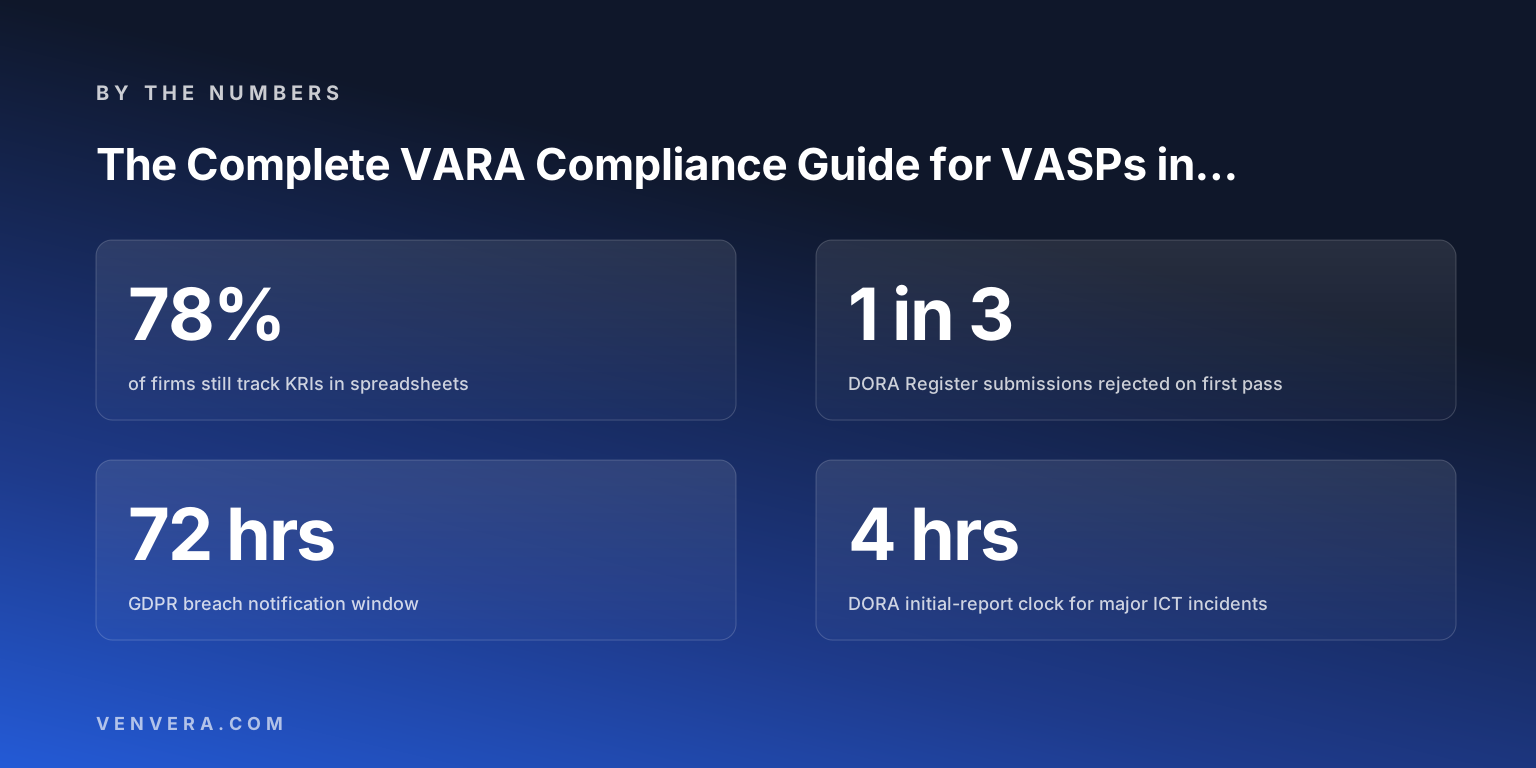
But here’s what I’ve learned from actually going through the licensing process with exchanges, custodians, and advisory platforms: the rulebook is demanding, but it’s also specific. Unlike some regulations that give you vague principles and then penalise you for interpreting them wrong, VARA tells you exactly what it wants. Eighteen cybersecurity policy criteria. Specific key management controls. A 72-hour incident notification window. Named CISO appointment requirements. There’s surprisingly little guesswork involved.
The companies that struggle aren’t the ones facing impossible requirements. They’re the ones who don’t know the requirements exist until a licensing review surfaces them. So this guide exists to make sure you aren’t one of those companies.
Why Dubai’s Approach Actually Works
I’m going to say something that might be unpopular with the “regulation kills innovation” crowd: VARA’s framework is one of the best things to happen to the crypto industry.
Before VARA, Dubai’s crypto market was the Wild West with nicer architecture. Companies set up, promised the moon, sometimes delivered, often didn’t. The 2022 collapses (Terra/Luna, FTX, Celsius) made it painfully obvious that self-regulation wasn’t working. Dubai’s response - establishing a dedicated virtual assets regulator with actual teeth - was both fast and thoughtful.
What makes VARA different from, say, MiCA in Europe or the patchwork of state-by-state rules in the US is that it was purpose-built for crypto. It wasn’t adapted from banking regulation. It wasn’t retrofitted from securities law. Someone actually sat down and thought about what a crypto exchange needs from a technology governance perspective, and built rules for that.
The result is a rulebook that covers things other regulators haven’t touched yet: cryptographic key lifecycle management, smart contract audit requirements, wallet segregation, blockchain-specific incident classification. It’s not just “apply banking rules to crypto.” It’s “here are the rules crypto actually needs.”
Who Needs to Care About This
The short answer: anyone who holds or wants a VARA licence. But let me be more specific, because “VASP” covers a surprisingly wide range of businesses.
VARA recognises seven categories of Virtual Asset Activities, and every single one is subject to the Technology and Information Rulebook:
Advisory Services
Portfolio advice, investment recommendations on virtual assets
Broker-Dealer Services
Buying and selling virtual assets on behalf of clients
Custody Services
Safekeeping of virtual assets and private keys
Exchange Services
Operating a trading platform for virtual assets
Lending & Borrowing
Facilitating virtual asset loans and DeFi lending
Management & Investment
Managing VA portfolios or investment schemes
Transfer & Settlement
Moving virtual assets between addresses, including payment services
One thing that catches people off guard: there’s no “lite” version. A small advisory firm with 10 employees faces the same structural requirements as a major exchange processing billions. VARA does allow proportionality - you can scale certain controls based on your size and complexity - but the core obligations apply to everyone.
And if you’re thinking “we’re in DIFC, so this doesn’t apply to us” - you’re right, DIFC falls under the DFSA. But everywhere else in Dubai is VARA territory.
What the Technology and Information Rulebook Actually Covers
I’m going to walk through the major pillars. Not in the order the rulebook presents them (which is structured for lawyers, not humans), but in the order that matters for implementation.
1. Technology Governance - The Foundation
Everything starts here. VARA wants to see a technology governance framework that’s approved by your board (or equivalent senior management body) and reviewed at least annually. This isn’t a checkbox exercise. They want evidence that senior leadership actually understands and owns the technology risk posture of the organisation.
What this means in practice: you need documented technology policies, a clear organisational structure for technology decision-making, defined roles and responsibilities, and a process for keeping the board informed about technology risks. If your CTO reports to the CEO and the board never hears about technology decisions, that’s a problem.
2. Cybersecurity - The 18 Criteria
This is where most of the work lives. VARA specifies 18 distinct criteria that your cybersecurity policy must address. Not “should consider.” Must address. These range from access control and network security to cryptographic controls, vulnerability management, and security monitoring. I’ve written a separate deep-dive on all 18 criteria, but the key insight is this: VARA’s cybersecurity expectations are closer to what you’d see in traditional banking regulation than what most crypto companies are used to.
You also need a CISO. Not “someone who handles security.” A named, appointed Chief Information Security Officer with defined qualifications, independence from the development team, and direct reporting to senior management. More on that here.
3. Cryptographic Key & Wallet Management
This is the section that’s unique to crypto regulation, and it’s surprisingly detailed. VARA doesn’t just say “protect your keys.” It specifies requirements for key generation (using approved algorithms), key storage (HSMs or equivalent), key rotation schedules, key backup and recovery procedures, key destruction, and the segregation of duties around key operations.
Wallet management gets similar treatment: hot/cold wallet segregation, balance thresholds for hot wallets, multi-signature requirements for large transactions, and real-time monitoring of wallet activity. If you’re a custodian, this section essentially defines your entire operational architecture. Full breakdown in this article.
4. Incident Reporting & Business Continuity
When something goes wrong - and in crypto, things go wrong - VARA wants to know about it within 72 hours. That’s the hard deadline for the initial notification. A detailed incident report follows within a timeframe VARA specifies based on the severity.
Your business continuity and disaster recovery (BCDR) plan needs to cover not just traditional IT scenarios (server failure, data centre outage) but crypto-specific ones: blockchain network congestion, smart contract vulnerabilities, private key compromise, and exchange liquidity crises. VARA wants to see that you’ve thought about what happens when the blockchain itself is the problem. Detailed guide here.
5. Penetration Testing & Smart Contract Audits
Annual penetration testing is mandatory. But VARA goes further than most regulators: if your platform relies on smart contracts, those contracts need independent security audits before deployment. Not internal code reviews. Independent, third-party audits by qualified firms. And the results need to be documented and available for regulatory inspection.
This is the section that DeFi protocols and tokenisation platforms usually underestimate. “We had a friend look at the code” doesn’t cut it. Details here.
6. Data Protection & UAE PDPL
VARA doesn’t exist in isolation. Your data protection obligations come from both the VARA rulebook and the UAE’s Federal Decree-Law No. 45 of 2021 (the Personal Data Protection Law). You need to handle KYC data, transaction records, and customer communications in compliance with both. This dual-compliance requirement is one of the trickier aspects of operating in Dubai. Full coverage in this article.
The DESC Factor Most People Miss
This catches people.
VARA’s rulebook explicitly requires alignment with the Dubai Electronic Security Center (DESC) standards. Your cybersecurity policies, access controls, and incident response procedures must satisfy both VARA and DESC requirements. It’s not an either/or. It’s both. At the same time. And DESC has its own set of controls that don’t perfectly overlap with VARA’s.
I’ve seen companies sail through VARA’s cybersecurity review only to get flagged during the DESC alignment check. The fix is straightforward but time-consuming: map your controls against both frameworks upfront, identify the gaps, and address them before you submit your licence application.
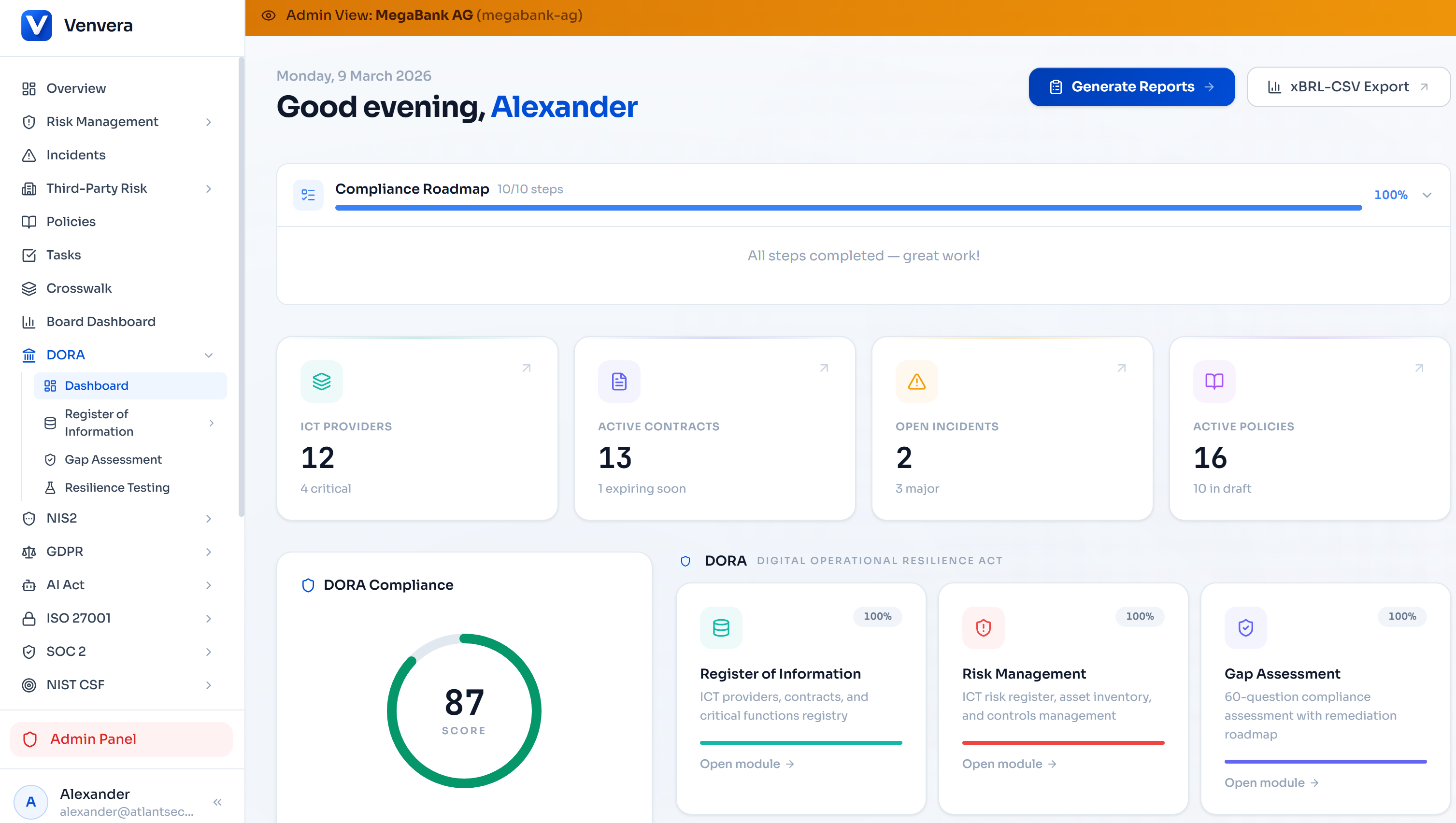
This is actually one of the areas where a multi-framework compliance platform pays for itself. Rather than maintaining two separate control matrices in two separate spreadsheets, you map once and track against both. Speaking of which - tools like Venvera support 13 regulatory frameworks including UAE-specific requirements, which makes this kind of cross-mapping significantly less painful.
The Five Mistakes I See Over and Over
After working with multiple VARA licence applicants, certain patterns emerge. Here are the five mistakes that delay or derail licensing applications most often:
Mistake 1: Treating cybersecurity policy as a document exercise
VARA doesn’t just want a written policy. They want evidence of implementation. Logs, configurations, test results, training records. If your policy says “we conduct quarterly vulnerability scans” and you can’t produce the last four scan reports, that’s a finding.
Mistake 2: Not appointing a CISO early enough
The CISO needs to be in place and involved in building the security programme, not bolted on at the end as a name on an org chart. VARA checks for this. They want to see that the CISO actually shaped the policies they’re supposed to oversee.
Mistake 3: Ignoring the smart contract audit requirement
DeFi and tokenisation platforms often assume their internal code reviews suffice. They don’t. VARA requires independent, third-party audits by qualified security firms. Start this process early - good audit firms are booked months in advance.
Mistake 4: Underestimating key management documentation
Most crypto companies have decent key management in practice. But “our CTO knows how the keys work” isn’t documentation. VARA wants written procedures for key generation, storage, rotation, backup, recovery, and destruction. Every step, documented, with audit trails.
Mistake 5: Forgetting about DESC
I mentioned this above, but it bears repeating: VARA compliance without DESC alignment is incomplete compliance. Build DESC into your control framework from day one.
Realistic Timeline: How Long Does This Actually Take?
Every consultant will tell you “it depends.” And it does. But let me give you real numbers based on what I’ve seen.
| Phase | What’s Happening | Duration |
|---|---|---|
| Gap Assessment | Map current state against VARA + DESC requirements | 2-4 weeks |
| Policy Development | Write/update all required policies and procedures | 4-8 weeks |
| Technical Implementation | Deploy controls, configure monitoring, set up key management | 6-12 weeks |
| Testing & Audits | Pen tests, smart contract audits, BCDR testing | 4-8 weeks |
| Application & Review | Submit to VARA, respond to queries, iterate | 8-16 weeks |
Total realistic timeline: 6 to 12 months from “we’re starting” to “we have a licence.” Companies with mature security programmes and existing compliance frameworks (ISO 27001, SOC 2) can move faster. Startups building from scratch should plan for the longer end.
The biggest time sink, consistently, is the application review phase. VARA is thorough. They ask detailed questions, request evidence, and often come back with follow-ups. Having well-organised documentation from the start - ideally in a proper compliance platform rather than scattered across Notion pages and Google Drives - makes this phase dramatically less painful.
Proportionality: What You Can Actually Scale
One of the smarter aspects of VARA’s framework is the proportionality principle. Not every VASP needs the same level of technical infrastructure. An advisory firm doesn’t need the same hot wallet monitoring as a major exchange.
Here’s what you can scale:
- Technical controls: The depth of your SOC, the sophistication of your monitoring, the frequency of certain tests
- Staffing: Whether the CISO is full-time or fractional (for smaller VASPs), the size of your security team
- Infrastructure: Whether you need dedicated HSMs or can use cloud-based key management solutions
Here’s what you cannot scale:
- The requirement itself: You still need a cybersecurity policy with all 18 criteria. You still need a CISO. You still need incident reporting.
- The 72-hour notification: That deadline applies to everyone, regardless of size.
- Smart contract audits: If you use smart contracts, they must be independently audited. No exceptions.
- Board-level governance: Senior management must own the technology governance framework. Period.
The proportionality principle is a useful tool, but don’t treat it as a loophole. VARA expects you to justify why a lighter-touch approach is appropriate. “We’re small” isn’t justification. “We’re an advisory firm that doesn’t hold client assets, so HSM-grade key management is disproportionate to our risk profile” is.
What Happens When You Get It Wrong
VARA isn’t a paper tiger. They’ve already demonstrated willingness to take enforcement action, including against well-known names. The consequences of non-compliance range from unpleasant to existential:
- Fines: Financial penalties that can reach into the millions of dirhams
- Licence conditions: Additional restrictions on your operations, mandatory remediation timelines
- Licence suspension: Temporary halt to some or all of your VA activities
- Licence revocation: Game over. You can no longer operate as a VASP in Dubai.
The reputational damage is arguably worse than the fines. In an industry where trust is already fragile, having your VARA licence suspended sends a signal to clients that’s very hard to recover from. It’s much cheaper - in every sense - to get compliance right the first time.
Where to Start (If You’re Starting Today)
If you’re reading this and thinking “we haven’t started any of this yet,” don’t panic. But do start moving. Here’s the order I’d tackle things:
First week: Get the Technology and Information Rulebook. Read it. All of it. Have your CTO and legal counsel read it too. Mark the sections that are going to require the most work. For most companies, that’s cybersecurity (Section III) and key management (Section V).
First month: Conduct a gap assessment. Map your current controls against every VARA requirement. Be honest about what you have and what you don’t. A structured compliance platform like Venvera can accelerate this significantly - it comes with pre-built assessment templates for UAE regulatory frameworks and tracks your progress across multiple frameworks simultaneously.
Second month: Appoint your CISO (or engage a fractional CISO if you’re smaller). Start developing your cybersecurity policy. Begin the smart contract audit process if applicable - this has the longest lead time.
Month three onward: Implement technical controls, conduct training, run your first pen test, test your BCDR plan. Build your evidence library as you go. Every document, every test result, every training record goes into a structured system.
By month six: You should be ready to start preparing your VARA application. Not filing it - preparing it. The application itself needs to demonstrate that everything is in place and operational, not planned.
The Bottom Line
VARA has built something genuinely impressive: a regulatory framework that takes crypto seriously without trying to pretend it’s traditional banking. The Technology and Information Rulebook is demanding, but it’s also fair. If you do the work, you’ll end up with a security and governance posture that actually protects your business and your clients - which is, believe it or not, good for everyone.
The crypto companies that thrive in Dubai over the next decade won’t be the ones that found clever ways around the rules. They’ll be the ones that embraced them early, built compliance into their operations, and used regulatory credibility as a competitive advantage.
Start now. Start honestly. And don’t try to do it in spreadsheets.
Get VARA-Ready Faster
Venvera supports 13 regulatory frameworks including UAE-specific requirements. Pre-built assessment templates, cross-framework mapping, and structured evidence management - starting at €399/month.
Book a Demo →Last updated: March 2026. This guide covers VARA’s Technology and Information Rulebook requirements as of publication date. Regulatory requirements may change - always verify current obligations with VARA directly.