Learn
I want to be honest with you about something upfront: there is no single document from the EBA, ESMA, or EIOPA that tells you everything you need to know about the DORA Register of Information in one place. The requirements are spread across the main DORA regulation text, the Joint Technical Standards, the ITS on registers of information, the xBRL taxonomy documentation, NCA-specific portal guidance, and a series of Q&As that the ESAs have published in response to industry questions - some of which clarify things that the original texts left genuinely ambiguous.

This guide is the document I wish had existed when compliance teams started working on their first submissions. It pulls everything together: what the Register of Information actually is, who has to submit it, what data goes into each of its 15 official templates, how the templates relate to each other, what the submission process looks like from start to finish, and what year-round maintenance looks like once your first submission is behind you.
By the time you finish reading this, you'll have a complete mental model of the RoI - not just enough to fill in a template, but enough to understand why each field exists, what the regulator is trying to see, and where the traps are for teams who are working through this for the first time.
CorrectionCorrected on 13 July 2026: replaced an earlier B00 to B14 summary with the official B_01.01 to B_99.01 template structure from Commission Implementing Regulation (EU) 2024/2956.
📋 What this guide covers: The legal basis and purpose of the Register of Information, who must submit and at what level, a template-by-template breakdown of the data model, the submission process and format requirements, ongoing maintenance obligations, and the most common mistakes teams make when building their register for the first time.
📌 Jump to section
⚡ TL;DR
The DORA Register of Information is a structured, relational dataset covering your ICT third-party providers, contracts, services, and their links to your critical internal functions. It must be submitted to your NCA annually in xBRL-CSV format. It is not a vendor list, not a risk register, and not a control framework - it is a specific regulatory reporting output built from 15 interconnected templates set by Commission Implementing Regulation (EU) 2024/2956. The active validation-rule count depends on the taxonomy and reporting-package version; this guide was checked against the version noted below. Managing it in Excel is possible for small registers but breaks down quickly as complexity grows.
What Is the DORA Register of Information?
The Register of Information (RoI) is one of the central operational requirements of the Digital Operational Resilience Act. It is defined under Article 28(3) of DORA, with detailed technical specifications set out in the Implementing Technical Standards (ITS) on registers of information published jointly by the EBA, ESMA, and EIOPA.
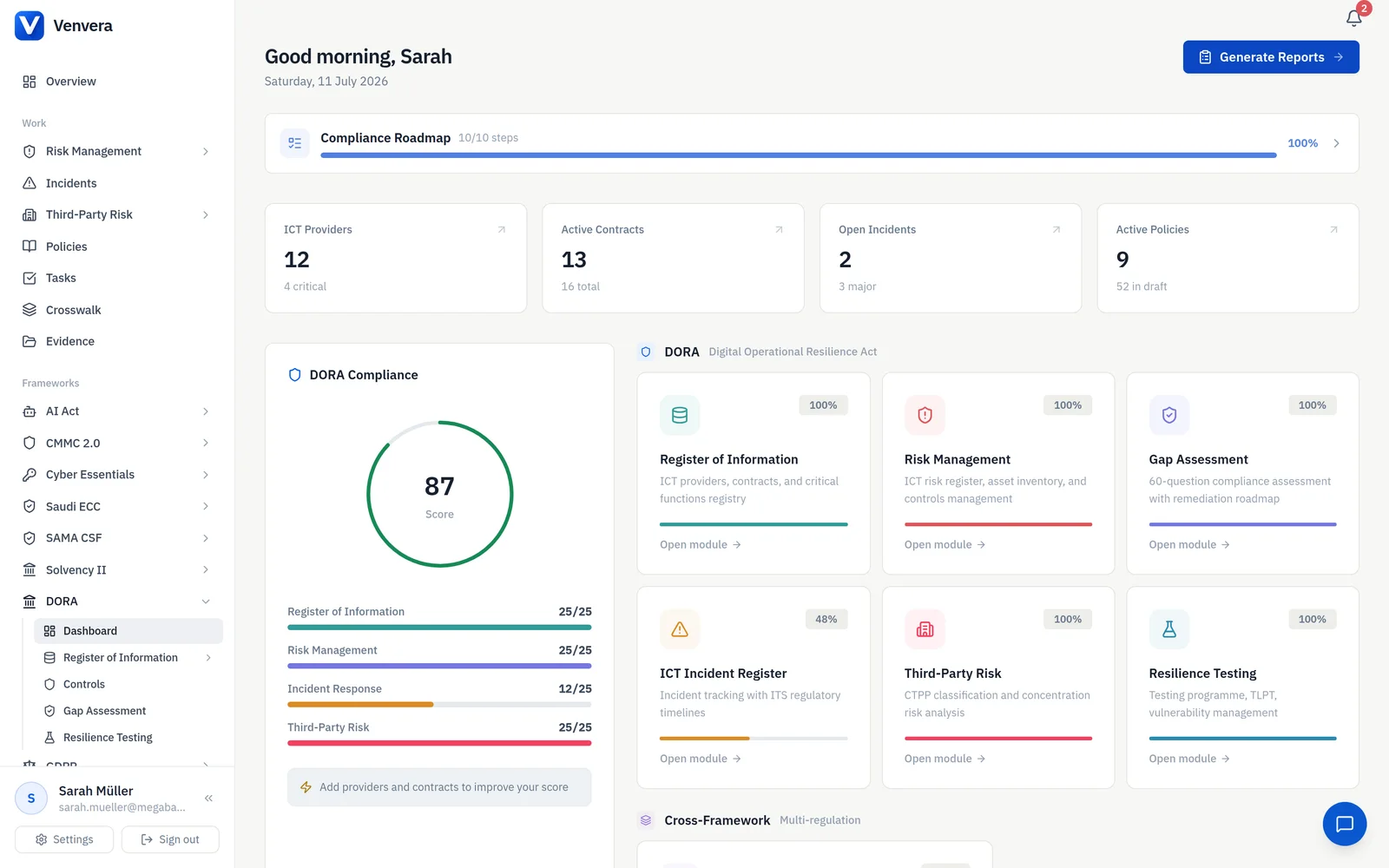
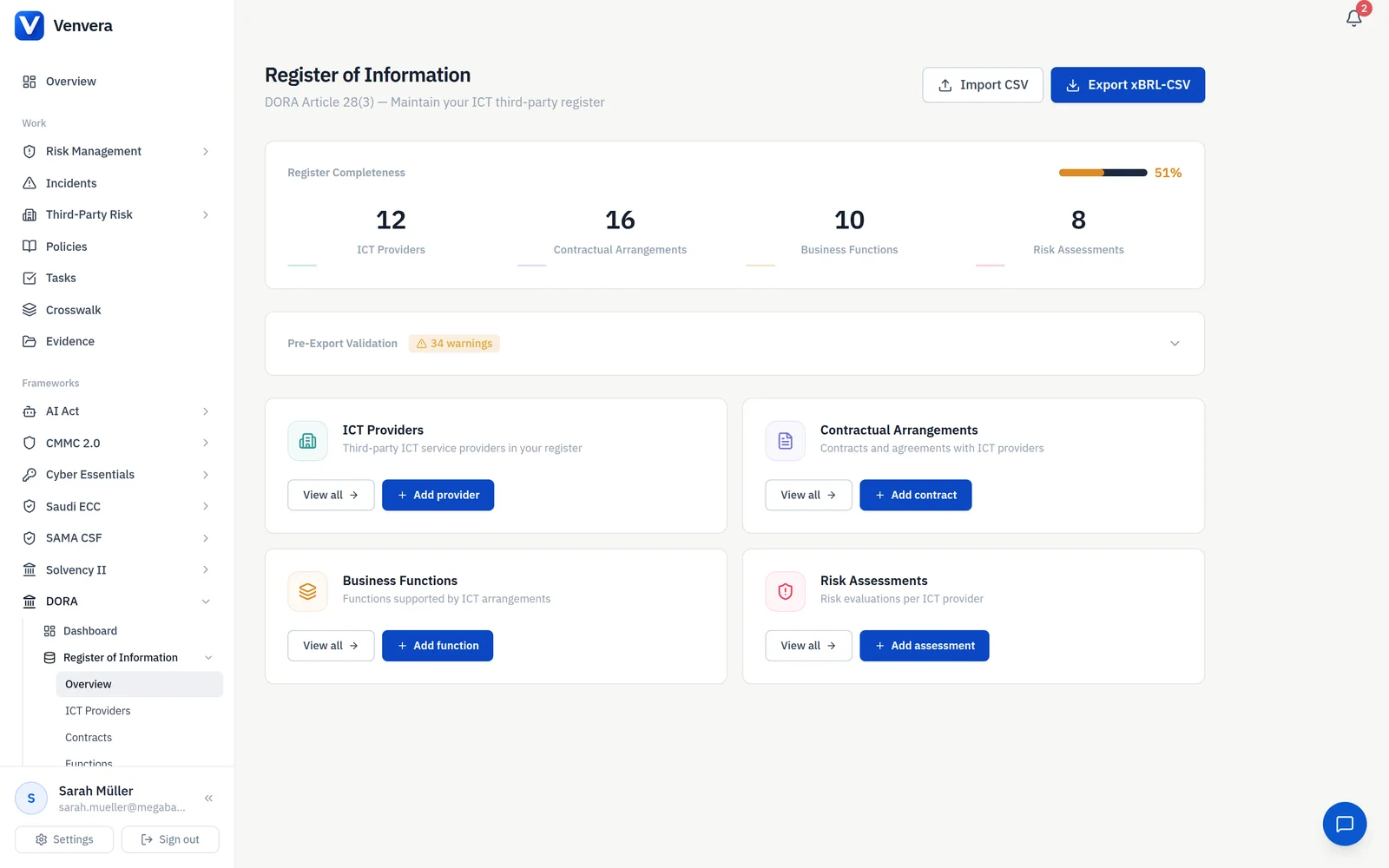
At its core, the RoI is a comprehensive, structured record of every ICT third-party service provider your organisation relies on - and a precise mapping of what those providers do, which contracts govern the relationship, and which of your internal business functions depend on their services. Regulators use this data for two primary purposes: to understand the concentration of risk across the financial system (if one cloud provider fails, which institutions are affected and how severely?), and to assess individual institutions' operational resilience and third-party risk governance.
What it is not is equally important to understand. The RoI is not:
- A vendor risk register - it doesn't capture risk scores, risk ratings, or risk mitigation measures for each provider. That's a separate DORA obligation.
- A contract management system - it captures specific structured data fields about contracts, but it's not a document repository for the contracts themselves.
- A compliance control framework - it doesn't track whether you've implemented the required ICT security controls. That's your ICT risk management framework under Articles 5-15.
- A one-time audit artifact - it's a live register that must be maintained continuously and updated within defined timeframes whenever something material changes.
⚠️ A common misconception
Many compliance teams initially approach the RoI as an extension of their existing third-party risk management program - essentially a structured export of their vendor register. This leads to problems. The RoI has a specific relational data model with mandatory fields and inter-table dependencies that don't map neatly onto vendor lists built for internal risk management purposes. Building the RoI correctly requires starting from the DORA data model, not from your existing vendor data.
Who Must Submit - and at What Level?
Article 28(3) of DORA requires all financial entities within scope of the regulation to maintain and submit a Register of Information. The full list of in-scope entities is defined in Article 2(1) and includes:
🏦 Credit institutions
💳 Payment institutions
📈 Investment firms
🪙 Crypto-asset service providers
🛡️ Insurance undertakings
📊 Central counterparties
🏛️ Trade repositories
📋 Management companies
Micro-enterprises - defined under EU law as entities with fewer than 10 employees and annual turnover under €2 million - benefit from proportionality provisions across DORA. How proportionality applies to the Register of Information depends on your entity type, so check the ESAs' proportionality guidance and your NCA's instructions for your specific case before deciding what you need to submit.
Individual, sub-consolidated, and consolidated submissions
For financial groups, the ITS specifies three possible submission levels. Understanding which applies to your structure is essential before you start building your register - because the answer determines the scope of data you need to collect and how entities within the group relate to each other in the data model.
| Submission level | Who submits | What it covers | Key considerations |
|---|---|---|---|
| Individual | Each in-scope legal entity | ICT arrangements of that entity only | Default requirement for all in-scope entities; standalone firms always submit at this level |
| Sub-consolidated | Parent of a sub-group | ICT arrangements of the sub-group's entities combined | Applies where a sub-group parent is itself an in-scope financial entity; data must be aggregated across all subsidiaries in scope |
| Consolidated | Ultimate EU parent undertaking | All in-scope entities across the group | Most complex - requires harmonised data collection across all jurisdictions and entity types in the group; each entity is listed in the scope-of-consolidation template (B_01.02), which records its role in the group structure |
Groups may need to produce all three levels simultaneously - individual submissions from each entity, sub-consolidated submissions from sub-group parents, and a consolidated submission from the ultimate EU parent. Each submission must be a coherent, self-consistent data package that passes validation independently.
The Data Model: 15 Templates Explained
Download: DORA Register of Information: the 15 official templates (CSV) - code, official name, purpose, group, primary key and key relationships for each template, aligned to Commission Implementing Regulation (EU) 2024/2956.
The RoI data model is the heart of the requirement and the part that most guides and templates explain least well. Understanding it properly - not just what each template contains, but how the templates relate to each other - is what separates teams who build the register correctly the first time from teams who spend months in a resubmission loop.
The backbone of the data model is the set of contractual arrangements you hold with ICT third-party service providers. Each arrangement carries a unique reference number, and that reference number is the key that ties the other templates together. Around that backbone you record who signed each arrangement, which of your entities use the services, the providers behind the services and their supply chains, the functions the services support, and the assessments you have made for services that support critical or important functions.
The register is built from 15 official templates set out in Commission Implementing Regulation (EU) 2024/2956. Their codes run from B_01.01 to B_99.01, and they are organised into groups keyed by the number after B_: 01 (entity and scope), 02 (contractual arrangements), 03 (signatories), 04 (entities using services), 05 (providers and supply chain), 06 (functions), 07 (assessments) and 99 (definitions).
| Template | Official name | Purpose | Group |
|---|---|---|---|
| B_01.01 | Entity maintaining the register | Identifies the financial entity responsible for maintaining the register. | Entity and scope |
| B_01.02 | List of entities within the scope of consolidation | Lists all entities within the group scope. | Entity and scope |
| B_01.03 | List of branches | Lists the branches of the entities in scope. | Entity and scope |
| B_02.01 | Contractual arrangements - general information | Lists every ICT third-party contractual arrangement, each with a unique reference number. | Contractual arrangements |
| B_02.02 | Contractual arrangements - specific information | Records the services and functions each arrangement supports and its terms (termination, governing law, storage location, whether an exit plan exists, and similar). | Contractual arrangements |
| B_02.03 | Intra-group contractual arrangements | Links intra-group arrangements to the related external provider contracts. | Contractual arrangements |
| B_03.01 | Entities signing the contractual arrangement | Records the financial-entity signatories to each arrangement. | Signatories |
| B_03.02 | ICT third-party service providers signing the contractual arrangement | Records the provider-side signatories to each arrangement. | Signatories |
| B_03.03 | Financial entities providing ICT services | Records intra-group entities that provide ICT services within the group. | Signatories |
| B_04.01 | Entities making use of the ICT services | Records which entities in scope actually use each ICT service. | Entities using services |
| B_05.01 | ICT third-party service providers | Full identification and details of each provider (name, LEI, country and similar). | Providers and supply chain |
| B_05.02 | ICT service supply chains | Records provider relationships and the subcontracting rank or hierarchy behind each service. | Providers and supply chain |
| B_06.01 | Functions identification | The entity-specific function taxonomy that classifies ICT-supported functions and their criticality. | Functions |
| B_07.01 | Assessments of the ICT services supporting critical or important functions | Records the assessments made for services that support critical or important functions. | Assessments |
| B_99.01 | Definitions | Internal terminology and closed-list value definitions provided by the entity. | Definitions |
How the templates connect
The reference number on each contractual arrangement (B_02.01) is the primary key that holds the register together. The specific information for that arrangement (B_02.02) hangs off the same reference number, as do the signatory records (B_03.01 for your side, B_03.02 for the provider side, and B_03.03 for intra-group providers) and the record of which entities use the services (B_04.01). Each service is delivered by a provider identified in B_05.01, and the chain of subcontractors behind it is set out in B_05.02. The functions your organisation runs are catalogued in B_06.01, and the assessments for services supporting critical or important functions sit in B_07.01. B_01.01 identifies the entity maintaining the register, B_01.02 and B_01.03 describe the group scope and branches, and B_99.01 holds the definitions you rely on.
Every reference in this chain must resolve. A single broken link - an arrangement in B_02.02 whose reference number has no match in B_02.01, or an assessment in B_07.01 pointing at a provider that is absent from B_05.01 - fails the whole submission at the validation stage.
Key Concepts: Criticality, Sub-Outsourcing, and Functions
Three concepts in the RoI data model deserve extra attention because they're the ones teams get wrong most often - and because getting them wrong affects not just your submission but your underlying compliance posture.
Critical or important functions (CIFs)
The concept of "critical or important functions" under DORA is defined in Article 3(22) and links directly to the EBA's guidelines on outsourcing. A function is critical or important when its disruption would materially impair the financial performance of the entity, or the soundness or continuity of its services or activities.
In practice, this means your organisation must make and document a formal assessment of each business function against these criteria. The RoI records the outcome of those assessments in the functions template (B_06.01). Common mistakes include: applying the criticality label too narrowly (underestimating which functions qualify, thereby understating your ICT dependency), applying it too broadly (over-classifying functions, creating unnecessary reporting scope), or failing to document the assessment methodology behind each classification - which regulators will ask for.
Sub-outsourcing chains
Article 28(2) requires financial entities to identify and document sub-outsourcing arrangements - situations where your direct ICT provider sub-contracts part of the service to another party. The supply-chain template (B_05.02) captures this, recording the subcontracting rank behind each service. In practice, it means you need to know not just who your providers are, but who their providers are, at least for arrangements supporting critical or important functions.
This is one of the most under-populated parts of first RoI submissions, for an obvious reason: gathering sub-outsourcing data requires your direct providers to disclose information about their supply chains that they may be reluctant to share. Your leverage here is contractual: Article 30(2)(a) requires the arrangement to state whether subcontracting of an ICT service supporting a critical or important function is permitted and, if so, the conditions that apply, and Commission Delegated Regulation (EU) 2025/532 sets out what those conditions must cover. Article 30(2)(h), sometimes cited for this, is about termination rights and notice periods, not supply-chain disclosure. Exercising the right still takes time and sometimes produces disputes. Starting this data collection exercise early - ideally 6 months before your first submission - is strongly advisable.
The provider-contract-service-function chain
The most important structural concept in the RoI is that every ICT arrangement must be traceable from provider all the way to internal function. This is not just a data model requirement - it reflects the regulator's actual analytical goal: to understand, for any given business function, exactly which external parties you depend on and through what contractual relationships. If that chain is broken anywhere in your data, the register fails its purpose even if it passes technical validation.
The Submission Process
Format
The RoI must be submitted in xBRL-CSV format - a structured, machine-readable format defined by the XBRL International standard and profiled for DORA by the ESAs. Your submission is a ZIP archive containing one CSV file for each table in the data model. Each CSV must conform to the XBRL taxonomy that the ESAs publish and update. The taxonomy defines field names, data types, controlled value lists, and the relationship constraints between tables.
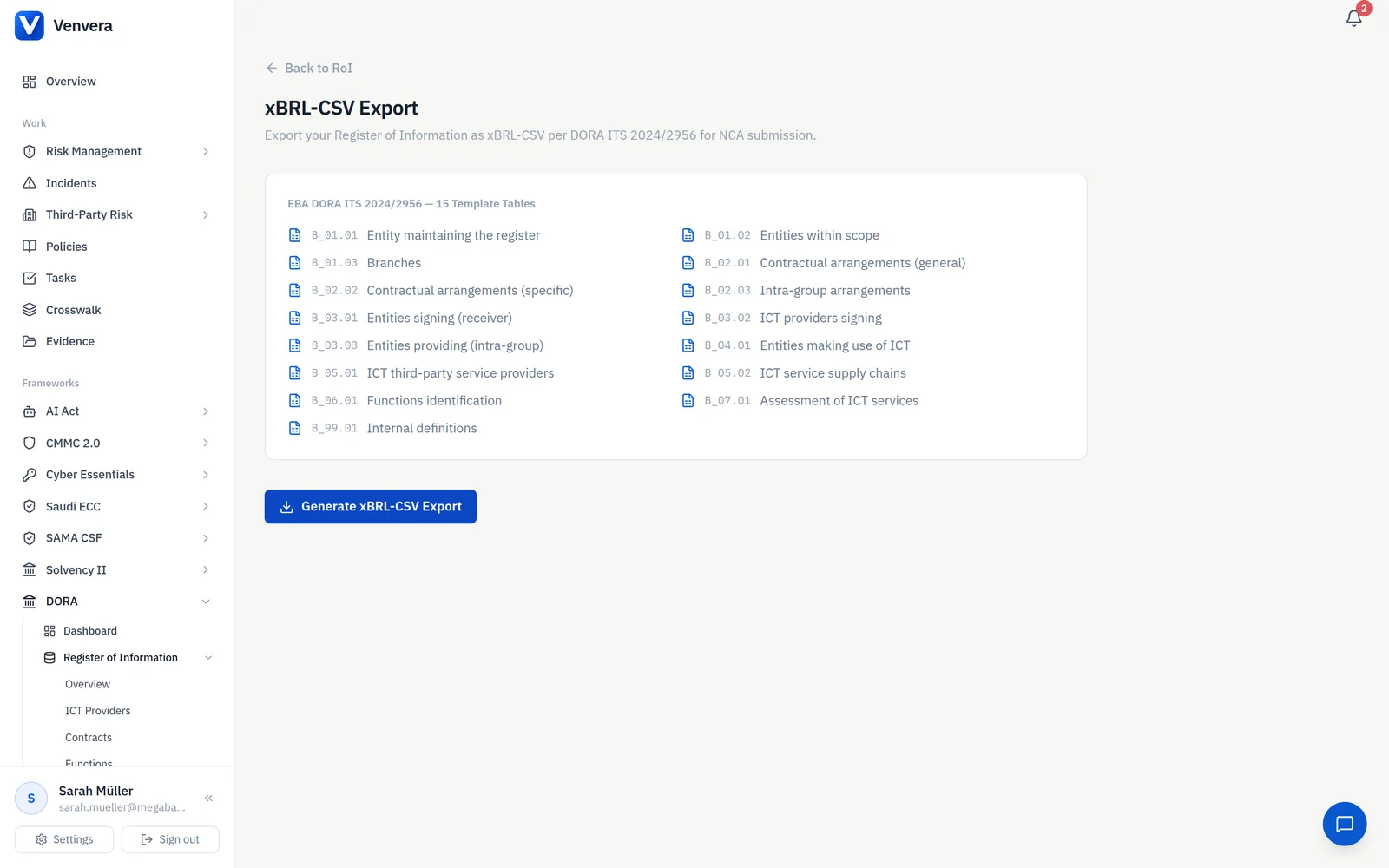
There is no provision for submitting in Excel format, PDF, or any other format. NCA portals only accept the xBRL-CSV ZIP. This is one of the most impactful practical requirements of DORA - it means that organisations maintaining their register in Excel must go through a conversion and validation process that introduces significant risk of error at the export stage.
Timing and deadlines
The annual submission deadline varies by NCA. Most NCAs have set deadlines in the first quarter of each calendar year, with the reference date being 31 December of the prior year - meaning your register must reflect the state of your ICT arrangements as of 31 December. Check your specific NCA's technical guidance for the exact filing deadline applicable to your entity type and jurisdiction.
The key operational implication: you cannot start building the register in January for a March deadline if your data collection processes aren't already in motion. The sub-outsourcing data alone can take months to gather. Organisations that treat the RoI as a year-end exercise consistently find themselves either submitting incomplete data or requesting extensions.
The NCA portal
Each EU member state's NCA operates its own submission portal. The portal requires registration, and submissions are made by authorised users whose identity is tied to the reporting entity. When you submit, the portal runs its validation sequence - package check, taxonomy conformance, referential integrity, controlled values, and business rules - and returns either a receipt confirmation or a feedback file containing error codes for each failure.
Year-Round Maintenance Obligations
This is the aspect of the RoI that surprises compliance teams most - particularly those who are used to compliance being primarily a point-in-time activity tied to audit cycles. The RoI is not something you build once a year and then archive. It is a living register with continuous maintenance obligations.
Article 28(3) requires financial entities to notify their NCA when material changes occur to ICT arrangements. The ITS specifies timeframes for updating the register following material changes - and "material" is defined more broadly than many compliance teams initially assume. The following events all require register updates:
| Triggering event | Templates affected | Update timeframe |
|---|---|---|
| New ICT third-party contract signed | B_02.01, B_02.02, B_05.01; often B_03.0x, B_04.01, B_07.01 | As soon as reasonably practicable; before next annual submission at latest |
| Existing contract terminated or renegotiated | B_02.01, B_02.02, plus the linked signatory, usage and assessment records | As soon as practicable following effective date |
| ICT provider changes name or is acquired | B_05.01 (and any LEI update) | Following notification from provider or public registry update |
| Sub-contractor changes for existing arrangement | B_05.02 | Upon notification from primary provider |
| Internal function classification changes | B_06.01, B_07.01 (and the specific information in B_02.02) | Following internal assessment completion |
| Data storage location changes | B_02.02 | Upon notification from provider |
The practical implication is that the RoI needs to be owned by someone - or some function - that is plugged into the contract lifecycle management and procurement processes of the organisation year-round. A compliance team that only touches the register once a year will consistently find that it no longer reflects reality by the time submission comes around, and that catching up in the weeks before the deadline is frantic, error-prone, and often incomplete.
Common First-Time Mistakes
Teams building their first Register of Information consistently encounter the same set of structural errors. Here are the most consequential ones, and how to avoid them.
❌
Starting with the ESA Excel template as your system of record
The ESA Excel template is a data collection aid, not a register management system. Its tabs are not linked, its identifiers are not enforced, and it provides no validation against the EBA's rules. Using it as your primary tool for a register of any significant size invites foreign key errors, inconsistent identifiers, and a painful manual conversion process at submission time.
❌
Conflating "vendor" with "ICT third-party service provider"
Your internal vendor list almost certainly contains providers who don't qualify as ICT third-party service providers under DORA's definition - and may be missing some who do. DORA focuses specifically on ICT services: IT infrastructure, software, data and analytics services, and similar. Office supplies, cleaning contractors, and professional advisory services are not ICT providers. Mapping from your vendor register without applying DORA's specific criteria leads to either over-scoping (unnecessary work) or under-scoping (incomplete submission).
❌
Leaving the supply-chain template (B_05.02) nearly empty
The vast majority of cloud providers, software vendors, and managed service providers rely on sub-contractors for at least some of their delivery - data centres, network providers, sub-processors. An empty or near-empty supply-chain template will draw NCA scrutiny because it is implausible for any organisation with more than a handful of ICT providers. Start gathering sub-outsourcing information from providers early, and make your right to this data explicit in new and renegotiated contracts.
❌
Treating the criticality assessment as a binary tick-box exercise
Classifying functions as critical or non-critical without a documented, methodical assessment process is a governance gap in itself - separate from whatever you put in the register. Regulators will ask how you made the determination. If the answer is "we looked at the list and used our judgement," that is unlikely to satisfy a supervisory review. The assessment should be documented, consistent, and tied to a defined methodology that references DORA's criteria.
❌
Not checking the taxonomy version before exporting
The DORA xBRL taxonomy is versioned, and the ESAs have published updates since the initial release. Submitting a package built against an older taxonomy version causes validation failures that can be difficult to diagnose. Always confirm which taxonomy version your NCA portal is currently accepting - and check for updates in the weeks before your submission date.
Tools and Approaches
There are three broad approaches organisations take to building and maintaining the Register of Information. Each has a different risk profile, and the right choice depends on the size and complexity of your register.
| Approach | Best suited for | Key risks |
|---|---|---|
| ESA Excel template + manual xBRL-CSV conversion | Entities with <30 providers and simple structures | Foreign key errors, date format corruption, controlled value typos, no pre-submission validation |
| General GRC platform with DORA framework overlay | Entities with multi-framework compliance needs who can accept manual RoI export workarounds | No native xBRL-CSV export; RoI data model not enforced; ICT-specific structure requires manual recreation |
| Purpose-built DORA RoI platform | Any entity with 30+ providers, multi-entity structure, or prior submission rejections | Vendor selection and onboarding time; integration with existing vendor data sources |
The case for a purpose-built platform becomes compelling quickly once you move beyond a small, simple register. The specific features that matter most for the RoI are: enforced referential integrity between tables, automated GLEIF LEI validation, hard constraints on controlled value fields, xBRL-CSV export that runs the current EBA validation rules before packaging, and audit trail management for updates made throughout the year. These aren't nice-to-haves - they're the capabilities that distinguish a register built for submission from a register that looks complete until the NCA portal tells you otherwise.
Build your Register of Information on a data model that won't break.
Venvera's RoI module enforces the relational structure, validates against the current EBA rule set before export, and produces a submission-ready xBRL-CSV package directly - no Excel, no manual conversion, no resubmission loops.
See Venvera in action → Venvera.comFrequently Asked Questions
How often does the DORA Register of Information need to be submitted?
The RoI is submitted annually, with the reference date being 31 December of the prior reporting year. NCAs may set specific submission deadlines - typically in Q1 of the following year - which can vary by jurisdiction and entity type. Check your NCA's published guidance for the exact deadline applicable to you.
Do all 15 templates need to be populated for every submission?
Not all templates carry data for every entity. Some are only relevant in particular circumstances - for example, the intra-group templates (B_02.03 and B_03.03) apply only to groups, and the assessments template (B_07.01) is populated for services that support critical or important functions. However, every required template file must be present in the ZIP even if it contains no data rows; an empty required file is different from a missing one, and a missing file causes a packaging failure.
What is the difference between a "provider" and a "sub-contractor" in the RoI?
A provider is an ICT third-party service provider with whom your organisation has a direct contractual relationship; each provider is identified in B_05.01. A sub-contractor is a party your direct provider uses to deliver part of the service to you, without a direct contractual relationship with your organisation; sub-contractors appear in the supply-chain template (B_05.02), which records the subcontracting rank behind each service. Both must be documented in the RoI, but they sit in different templates and are captured through different fields.
What happens if we discover an error in our submitted register after the deadline?
You should contact your NCA and submit a corrected version as soon as possible. DORA's requirement is for an accurate, up-to-date register - submitting an incorrect version and leaving it uncorrected is a worse outcome than submitting a correction after the fact. NCAs generally prefer entities that proactively identify and correct errors over those that allow inaccurate data to stand.
Does the DORA Register of Information replace any existing reporting obligations?
The RoI is specific to DORA and does not replace reporting obligations under other regulatory frameworks. However, the data gathered for the RoI often overlaps with data needed for other purposes - vendor risk assessments, GDPR data mapping, outsourcing notifications, and business continuity documentation. Organisations that build the RoI properly find that it becomes a valuable data asset for these adjacent obligations, not just a standalone submission exercise.
Written by the Venvera compliance team. Venvera is a purpose-built DORA compliance platform for European financial entities. Last updated: July 2026. Reviewed against Commission Implementing Regulation (EU) 2024/2956; the specific xBRL taxonomy and reporting-package version in force, and its validation-rule set, should be confirmed with your NCA before each submission.