

Learn
If you work in compliance, risk, or technology governance at a European financial institution, you’ve almost certainly been told that ISO 42001 is the answer to AI compliance. Vendors like Vanta and Drata market ISO 42001 certification programs prominently. LinkedIn is filled with consultants offering to “get you AI Act compliant” through ISO 42001. The implication is clear: get certified, check the box, move on.
The reality is more nuanced - and getting it wrong carries real consequences.
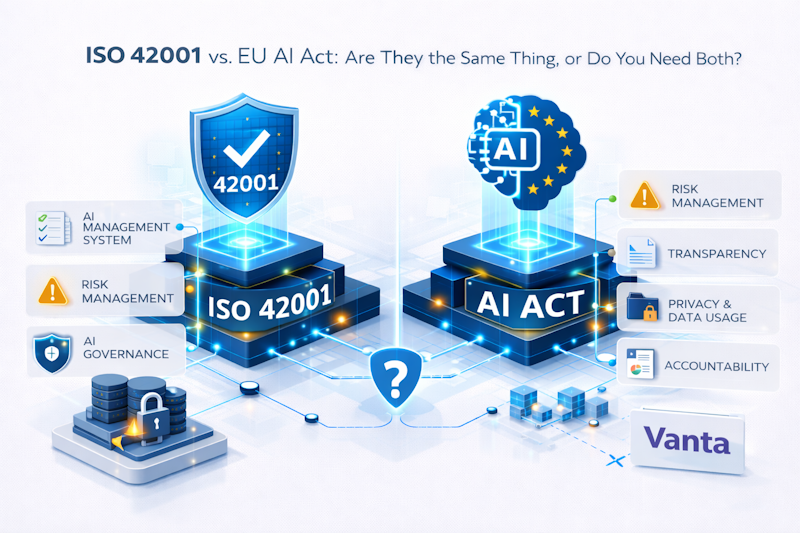
ISO 42001, published in December 2023, is the world’s first international standard for AI Management Systems (AIMS). It provides a structured framework for organizations to govern AI responsibly across its entire lifecycle. The EU AI Act, which entered into force in August 2024, is the world’s first comprehensive AI law - a binding regulation with penalties reaching €35 million or 7% of global turnover.
They sound similar. They both address AI risk. They even share some vocabulary. But they are fundamentally different instruments with different legal weight, different scopes, and different enforcement mechanisms. This article breaks down exactly where they converge, where they diverge, and what that means for your organization in 2026.
📜
Understanding the Standard
What ISO 42001 Actually Is
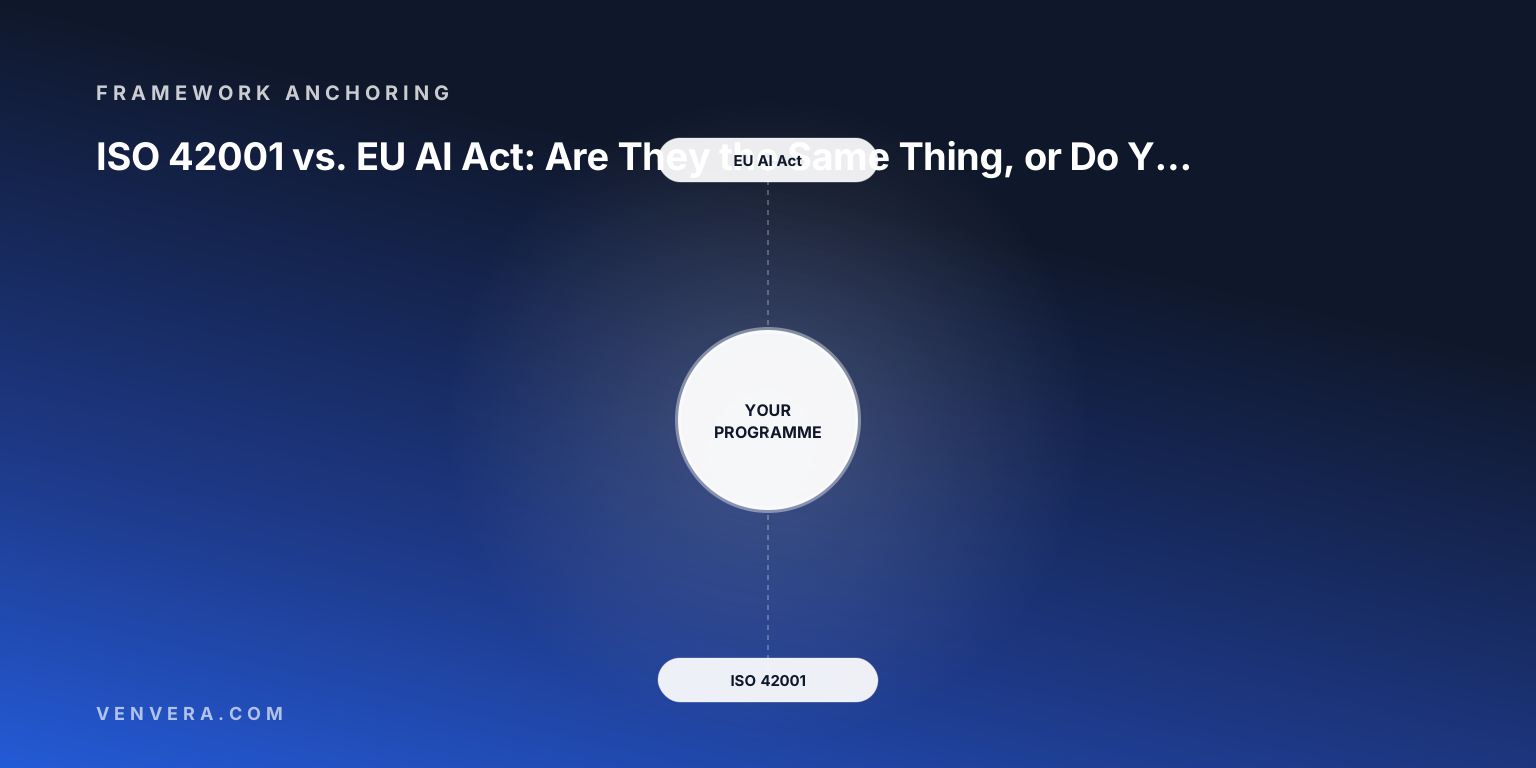
ISO/IEC 42001:2023 is an international standard developed by the ISO/IEC JTC 1/SC 42 committee. It specifies requirements for establishing, implementing, maintaining, and continually improving an AI Management System (AIMS) within an organization. If you’re familiar with ISO 27001 for information security or ISO 9001 for quality management, ISO 42001 follows the same Annex SL high-level structure.
Key Characteristics of ISO 42001
- Voluntary - No legal requirement to adopt it. Organizations choose certification to demonstrate governance maturity.
- Organizational scope - Covers how the organization manages AI, not how any individual AI system performs.
- Lifecycle coverage - Addresses AI from design and development through deployment, operation, and decommissioning.
- Risk-based - Clause 6 requires organizations to identify and assess AI-related risks and determine appropriate treatment.
- Annex-driven controls - Annex A contains 38 controls across 9 domains, including responsible AI principles, data governance, third-party management, and impact assessment.
- Certifiable - Organizations can be audited and certified by accredited certification bodies. First certifications were issued in mid-2024.
ISO 42001 is a genuinely useful standard. It forces organizations to think systematically about AI governance - who is responsible, how risks are assessed, how models are documented, how stakeholders are engaged. For organizations with no AI governance framework, it provides an excellent starting structure. The question is whether that structure satisfies legal obligations.
⚖
Understanding the Law
What the EU AI Act Requires
The EU AI Act (Regulation 2024/1689) is a binding legal instrument that applies directly across all 27 EU member states. It doesn’t suggest best practices - it imposes enforceable obligations with significant penalties for non-compliance. The regulation uses a risk-based classification system that determines which obligations apply to which AI systems.
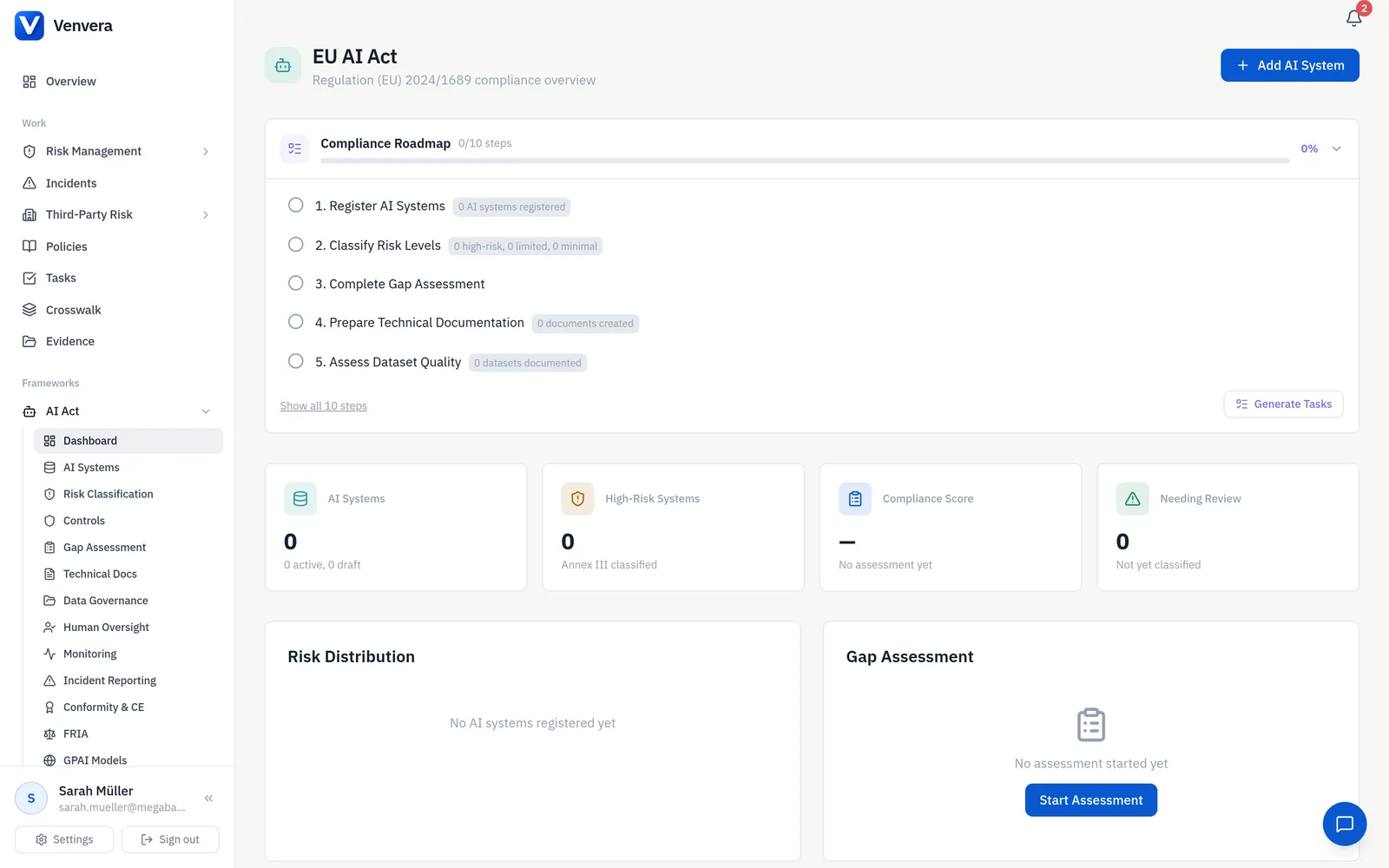
EU AI Act Risk Categories
- Unacceptable risk (Art. 5) - Prohibited outright. Social scoring, real-time biometric identification in public spaces (with exceptions), manipulation of vulnerable groups, emotion recognition in workplaces/education. Effective February 2025.
- High risk (Art. 6, Annex III) - Permitted but heavily regulated. Includes AI in credit scoring, insurance pricing, recruitment, law enforcement, critical infrastructure. Full obligations apply from 2 December 2027 (postponed from August 2026 by the Digital Omnibus).
- Limited risk (Art. 50) - Transparency obligations. Chatbots must disclose they are AI; deepfakes must be labeled. Effective August 2025.
- Minimal risk - No specific obligations, though voluntary codes of conduct are encouraged.
For financial institutions, the high-risk category is where the action is. AI systems used for creditworthiness assessment, insurance risk pricing, fraud detection, and anti-money laundering typically fall into Annex III, Category 5(b). These systems must comply with Articles 8-15 before being placed on the market or put into service - covering risk management, data governance, technical documentation, record-keeping, transparency, human oversight, accuracy, robustness, and cybersecurity.
Enforcement Is Real
Penalties under the AI Act are structured in tiers: up to €35 million or 7% of global turnover for deploying prohibited AI systems, up to €15 million or 3% for violating high-risk obligations, and up to €7.5 million or 1% for supplying incorrect information. National market surveillance authorities and the newly established EU AI Office share enforcement responsibilities.
📈
Side by Side
Head-to-Head: ISO 42001 vs. EU AI Act
The following comparison across 14 dimensions reveals just how different these two instruments are - despite sharing a common subject matter.
| Dimension | ISO 42001 | EU AI Act |
|---|---|---|
| Nature | Voluntary international standard | Mandatory EU regulation (law) |
| Legal force | None - contractual or reputational value only | Directly applicable across 27 EU member states |
| Scope | All AI systems within the organization’s AIMS scope | AI systems classified by risk level; obligations vary per category |
| Risk approach | Organizational risk assessment (Clause 6.1) | System-level risk classification (Art. 6, Annex III) |
| Documentation | AIMS documentation, policies, AI impact assessments | Per-system technical documentation (Art. 11, Annex IV) with prescribed content |
| Testing requirements | General requirement for performance evaluation (Clause 9) | Specific testing for accuracy, robustness, cybersecurity (Art. 15); testing prior to deployment (Art. 9(7)) |
| Transparency | Organizational transparency policy (Annex A, A.5) | Per-system transparency to users (Art. 13); disclosure obligations for chatbots/deepfakes (Art. 50) |
| Human oversight | General governance requirement | Specific technical measures for human intervention (Art. 14); “stop button” capability |
| Conformity assessment | Third-party certification audit against the standard | Self-assessment or notified body assessment per system (Art. 43); CE marking required |
| Prohibited practices | Not addressed | Explicit list of banned AI uses (Art. 5) |
| Penalties | Loss of certification; reputational impact | €7.5M-€35M or 1%-7% of global turnover |
| Enforcement body | Accredited certification bodies (e.g., BSI, TÜV) | National market surveillance authorities + EU AI Office |
| Geographic reach | Global (any organization can adopt) | EU market + extraterritorial (any provider placing systems in the EU) |
| GPAI obligations | Not addressed | Specific obligations for general-purpose AI models (Art. 51-55) |
The table makes the distinction stark: ISO 42001 certifies that your organization has a management system. The EU AI Act requires that each individual AI system meets specific technical and legal requirements. One is about governance maturity; the other is about product compliance.
✅
Genuine Overlap
Where ISO 42001 Helps With EU AI Act Compliance
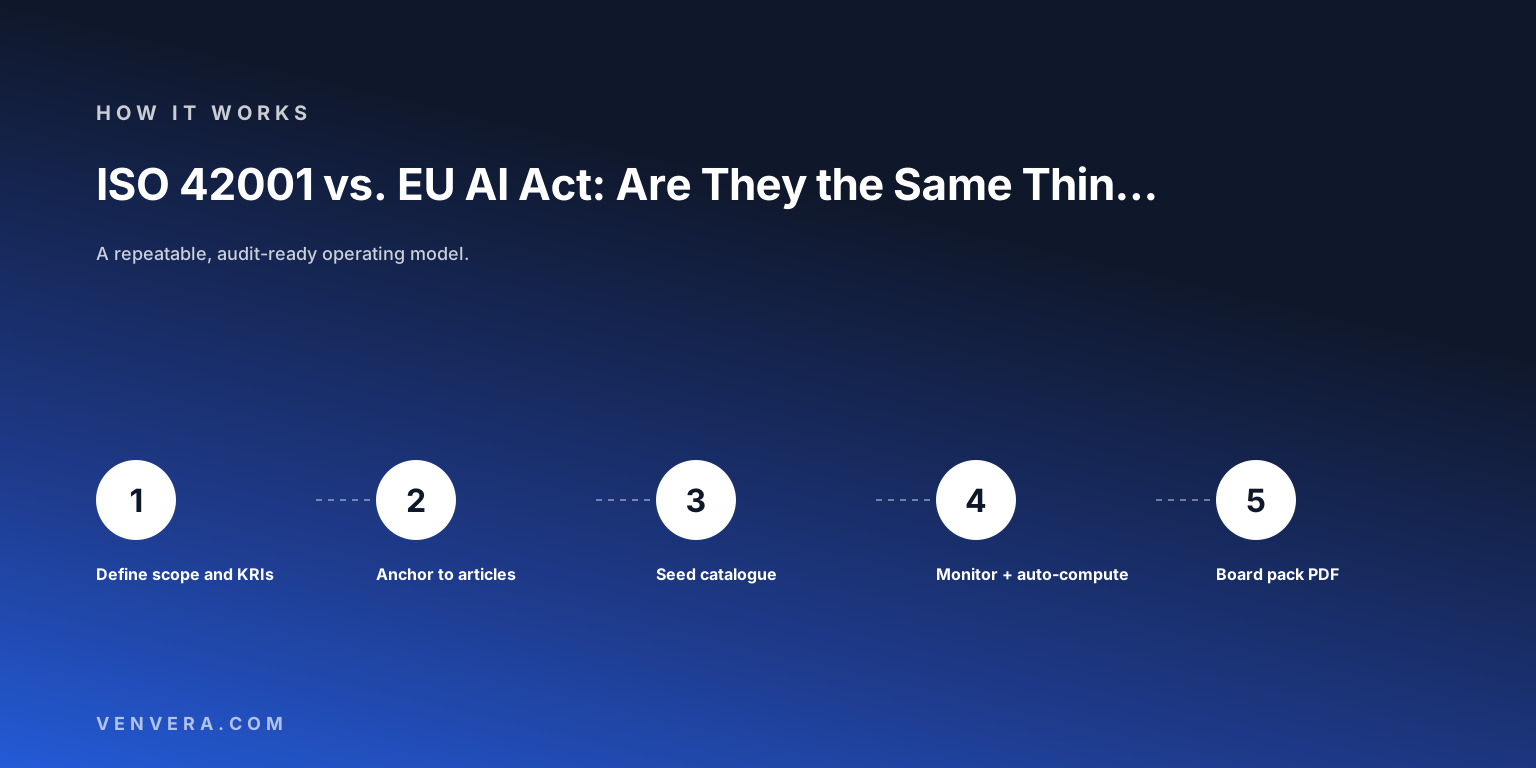
To be fair to ISO 42001, there is substantial genuine overlap. An organization that has implemented a robust AIMS will be significantly better positioned for EU AI Act compliance than one starting from scratch. Here are the areas of meaningful convergence:
Five Areas of Real Alignment
1. Risk Management Framework
ISO 42001 Clause 6.1 requires organizations to establish a systematic AI risk assessment process. The EU AI Act Article 9 requires a risk management system for high-risk AI. The ISO framework provides the governance structure and methodology that Article 9 demands - even though the Act requires this at the individual system level, the organizational process from ISO 42001 translates directly.
2. Documentation and Record-Keeping
ISO 42001 Clause 7.5 and Annex A controls (A.6.2.4, A.6.2.5) establish documentation practices including AI system descriptions, data documentation, and records of decisions. The AI Act Articles 11-12 and Annex IV require detailed technical documentation and automatic logging. The habits and infrastructure built for ISO compliance provide a solid documentation foundation.
3. Data Governance
ISO 42001 Annex A control A.7 addresses data quality, provenance, and fitness for purpose. The EU AI Act Article 10 requires data governance practices for training, validation, and testing datasets. Organizations that have formalized data governance under ISO 42001 will find much of the Article 10 groundwork already in place.
4. Monitoring and Continuous Improvement
ISO 42001 Clause 9 (performance evaluation) and Clause 10 (improvement) establish monitoring, measurement, analysis, and corrective action processes. The AI Act Article 72 requires post-market monitoring for high-risk systems. The ISO monitoring culture and infrastructure directly supports this obligation.
5. Governance Structure
ISO 42001 Clause 5 (leadership) requires top management commitment, defined roles and responsibilities, and an AI policy. The AI Act requires deployers to have appropriate governance structures (Art. 26). ISO 42001 creates exactly the kind of organizational accountability the Act assumes exists.
“ISO 42001 certification is to AI Act compliance what ISO 27001 certification is to GDPR compliance: it demonstrates organizational maturity and establishes good practices, but it does not, on its own, satisfy the legal requirements.”
⚠
Critical Gaps
Where ISO 42001 Certification Falls Short
This is where it gets serious. Despite the overlap, there are seven significant areas where ISO 42001 certification alone leaves you exposed to EU AI Act non-compliance. Each represents a gap that must be addressed through separate, targeted compliance work.
Gap 1: System-Level Conformity Assessment (Art. 43)
The AI Act requires a conformity assessment for each high-risk AI system before it can be placed on the market. Depending on the system type, this may be a self-assessment or require a notified body. ISO 42001 certification is an organizational assessment - it says nothing about whether any specific system meets the Act’s technical requirements. You can be ISO 42001 certified and still have non-compliant AI systems.
Gap 2: Specific Technical Requirements for High-Risk Systems (Art. 8-15)
The AI Act prescribes specific technical requirements: accuracy metrics must be declared and met (Art. 15(1)), robustness against errors and adversarial attacks must be ensured (Art. 15(4)), cybersecurity measures must be proportionate to risks (Art. 15(5)), and automatic logging must capture specific events (Art. 12). ISO 42001 addresses these topics at a policy level but does not require the per-system technical evidence the Act demands.
Gap 3: Transparency Requirements Per System (Art. 13, Art. 50)
ISO 42001 establishes a transparency policy. The AI Act requires specific per-system disclosures: high-risk systems must provide instructions of use that explain the system’s intended purpose, accuracy levels, known limitations, and human oversight measures (Art. 13). Additionally, chatbots and deepfake generators have specific disclosure obligations (Art. 50). A general transparency policy does not satisfy these granular per-system requirements.
Gap 4: Prohibited AI Practices (Art. 5)
The AI Act explicitly prohibits certain AI applications: social scoring, exploitation of vulnerabilities, untargeted facial image scraping, emotion recognition in workplaces and education, and certain biometric categorization systems. ISO 42001 has no equivalent provision. An organization can be fully ISO 42001 certified while operating AI systems that are illegal under the AI Act.
Gap 5: General-Purpose AI Model Obligations (Art. 51-55)
The AI Act introduces specific obligations for providers of general-purpose AI (GPAI) models, including technical documentation, downstream provider information, copyright compliance, and - for models with systemic risk - adversarial testing, incident reporting, and model evaluation. ISO 42001 was published before the GPAI provisions were finalized and does not address these obligations at all.
Gap 6: EU Database Registration (Art. 49, Art. 71)
Providers and deployers of high-risk AI systems must register in the EU public database before the system is placed on the market (Art. 49). Deployers that are public authorities must also register (Art. 49(3)). This is a specific procedural obligation with no ISO 42001 equivalent. Certification does not register your systems.
Gap 7: Post-Market Monitoring Specifics (Art. 72)
While ISO 42001 requires general monitoring and improvement, the AI Act specifies that high-risk system providers must establish a post-market monitoring system that is proportionate to the nature and risks of the system, must actively and systematically collect and analyze data, and must feed into the risk management system. The Act also requires serious incident reporting to authorities (Art. 73) within defined timeframes - something ISO 42001 does not address.
⚖
The Bottom Line
The Verdict: You Need Both, but for Different Reasons
The answer to the title question is clear: ISO 42001 and the EU AI Act are not the same thing, and yes, you likely need to address both. But they serve different purposes and should be understood as complementary, not interchangeable.
ISO 42001 Is Your Foundation
- Organizational AI governance maturity
- Systematic risk management processes
- Documentation culture and infrastructure
- Stakeholder confidence and market signal
- Continuous improvement framework
EU AI Act Is Your Legal Obligation
- System-level technical compliance
- Conformity assessment per AI system
- Prohibited practice screening
- EU database registration
- Incident reporting to authorities
Think of it this way: ISO 42001 is like getting your driver’s education - it teaches you how to be a responsible driver. The EU AI Act is the Highway Code - it defines the specific rules you must follow on the road, with police enforcing them and fines for violations. Having the education makes you more likely to follow the rules, but it doesn’t exempt you from them.
“ISO 42001 certification is a good foundation for EU AI Act compliance, not a substitute for it. The standard builds governance maturity; the law demands specific system-level evidence. Both are valuable. Neither is sufficient alone.”
It’s worth noting that the European Commission explicitly recognizes harmonized standards as a path to presumption of conformity with the AI Act (Art. 40). However, as of mid-2026, ISO 42001 has not been cited in the Official Journal as a harmonized standard under the AI Act. The European standardization organizations (CEN/CENELEC) are developing AI Act-specific harmonized standards through JTC 21, but these are separate from ISO 42001. Until harmonized standards are formally published, no voluntary standard - including ISO 42001 - provides presumption of conformity.
🔍
Market Reality Check
What Compliance Vendors Get Wrong About “AI Compliance”
Here is where the market messaging deserves scrutiny. Platforms like Vanta and Drata prominently feature ISO 42001 certification programs and use language like “AI compliance” and “AI governance” in their marketing. There is nothing inherently wrong with offering ISO 42001 support - it’s a valuable standard. The problem is the implication.
The Messaging Gap
When a vendor markets “AI compliance” to a European financial institution but only delivers ISO 42001 certification tooling, the label can create a false sense of completeness. The compliance officer sees “AI compliance” on their dashboard and checks a mental box. Meanwhile:
- No one has classified their AI systems under the AI Act risk categories
- No per-system conformity assessments have been conducted
- No systems have been checked against the prohibited practices list
- No registration in the EU database has occurred
- Technical documentation per Annex IV does not exist for any system
- No post-market monitoring plan meets Art. 72 specifics
This is not about criticizing ISO 42001 as a standard - it is genuinely well-designed. It is about criticizing marketing that conflates organizational governance certification with legal regulatory compliance. They are different things. Compliance teams deserve clear, honest guidance about what each instrument covers and where the gaps remain.
A responsible vendor should help you achieve ISO 42001 certification and map the specific AI Act obligations that apply to your systems. Treating them as one and the same leaves you exposed, whether by misunderstanding or oversimplification.
🎯
Our Approach
How Venvera Approaches AI Governance
We built Venvera’s AI Act module with the distinction between organizational governance and system-level compliance at its core. Rather than treating ISO 42001 certification as “AI compliance done,” we approach it as two complementary layers:
Layer 1: AI System Register & Risk Classification
Every AI system your organization develops, deploys, or distributes gets registered with its risk classification under the AI Act. High-risk systems are tracked through the full compliance lifecycle: conformity assessment, technical documentation, transparency obligations, human oversight measures, post-market monitoring, and EU database registration status.
This is system-level compliance - the part that ISO 42001 does not cover.
Layer 2: Organizational Governance Tracking
Alongside system-level tracking, we provide governance maturity assessment aligned with ISO 42001 controls. Risk management processes, data governance policies, roles and responsibilities, stakeholder engagement, and continuous improvement - all tracked at the organizational level.
This supports both ISO 42001 certification readiness and the AI Act’s implicit expectation of organizational governance maturity.
And because Venvera already manages DORA, GDPR, ISO 27001, NIS2, and other frameworks, the cross-framework control mapping means that AI governance doesn’t exist in a silo. An AI system processing personal data triggers both AI Act and GDPR obligations in the same platform. A credit scoring model used by a DORA-regulated entity maps across three frameworks simultaneously. This is how real compliance works - not in framework-by-framework silos.
📅
Timeline
Key EU AI Act Dates You Cannot Ignore
The AI Act’s phased implementation means obligations are becoming enforceable right now. ISO 42001 certification has no equivalent deadlines - it’s on your schedule. The law is not.
| Date | What Takes Effect | Status |
|---|---|---|
| 1 August 2024 | AI Act enters into force | ✓ Done |
| 2 February 2025 | Prohibited practices (Art. 5) enforceable; AI literacy obligations (Art. 4) | ✓ Done |
| 2 August 2025 | GPAI model obligations (Art. 51-55); governance bodies established; penalties framework active | ✓ Done |
| 2 August 2026 | Transparency obligations (Art. 50): chatbots, deepfakes and synthetic content labelling. The Digital Omnibus left this date in place. | Upcoming |
| 2 December 2027 | High-risk AI systems (Art. 6, Annex III): conformity assessment, technical documentation, deployer obligations (Art. 26). Postponed from August 2026 by the Digital Omnibus. | Upcoming |
| 2 August 2028 | High-risk AI embedded in regulated products (Annex I). Postponed from August 2027 by the Digital Omnibus. | Upcoming |
For Financial Institutions: December 2027 Is Now the High-Risk Deadline
AI systems used in credit scoring, insurance risk assessment, fraud detection, and AML - which fall under Annex III, Category 5(b) - must comply by 2 December 2027, the date the Digital Omnibus moved this to from August 2026. ISO 42001 certification takes 6-12 months to achieve. Mapping and remediating AI Act obligations for each system takes similar time. If your organization hasn’t started both workstreams, the clock is uncomfortably tight.
🛠
Action Plan
Practical Recommendations for 2026
Based on the analysis above, here is what we recommend for European financial institutions approaching AI governance in 2026:
Step 1: Build Your AI System Inventory
Before pursuing any certification or compliance program, create a comprehensive inventory of every AI system your organization develops, deploys, or procures. Include third-party AI embedded in other products. You cannot classify what you cannot see.
Step 2: Classify Each System Under the AI Act
Map each AI system against the AI Act’s risk categories. Screen for prohibited practices first (Art. 5). Then assess against Annex III high-risk categories. For financial services, pay particular attention to Category 5(b) (creditworthiness and credit scoring) and Category 5(a) (insurance pricing).
Step 3: Pursue ISO 42001 as Governance Foundation
Use ISO 42001 to establish your organizational AI governance framework. This builds the processes, documentation culture, risk management methodology, and governance structures that support - but do not replace - system-level AI Act compliance.
Step 4: Address System-Level AI Act Gaps
For each high-risk AI system, work through the specific obligations: technical documentation (Annex IV), conformity assessment (Art. 43), transparency disclosures (Art. 13), human oversight measures (Art. 14), accuracy and robustness testing (Art. 15), post-market monitoring plans (Art. 72), and EU database registration (Art. 49).
Step 5: Choose Tooling That Understands Both
Select a compliance platform that distinguishes between organizational governance and system-level compliance. Beware vendors that present ISO 42001 certification as the entirety of “AI compliance.” Your tooling should track both layers and make the gaps visible.
Frequently Asked Questions
Does ISO 42001 certification make me EU AI Act compliant?
No. ISO 42001 certifies an organizational AI management system; the EU AI Act imposes per-system legal obligations - risk classification, conformity assessment, technical documentation, and EU database registration. ISO 42001 is a strong foundation that accelerates the governance groundwork, but it is not a substitute, and it does not on its own grant presumption of conformity with the Act.
When do the EU AI Act high-risk obligations apply now?
The Digital Omnibus on AI, adopted by the Council on 29 June 2026, postponed the high-risk dates. Standalone high-risk systems under Annex III apply from 2 December 2027, and high-risk AI embedded in regulated products under Annex I from 2 August 2028. The Article 50 transparency obligations still apply from 2 August 2026, and the prohibitions (February 2025) and general-purpose AI obligations (August 2025) are already in force.
Do I need both ISO 42001 and EU AI Act compliance?
If you operate high-risk AI in the EU, the AI Act is mandatory. ISO 42001 is voluntary. Most regulated organisations benefit from both: ISO 42001 for organizational maturity and a defensible governance system, the AI Act for the system-level legal evidence a regulator can demand.
Does ISO 42001 give presumption of conformity with the AI Act?
Not currently. Only harmonised standards cited in the Official Journal give a presumption of conformity under Article 40. CEN and CENELEC (JTC 21) are developing AI Act harmonised standards, but ISO 42001 has not been cited as one as of mid-2026.
How is ISO 42001 structured?
ISO/IEC 42001:2023 follows the same Annex SL high-level structure as ISO 27001, with an AI management system built on leadership, planning, risk assessment, and continual improvement, plus Annex A controls across nine areas covering responsible AI policies, data governance, third-party management, and impact assessment.
Primary sources
This comparison draws on the primary texts and official guidance: the EU AI Act, Regulation (EU) 2024/1689 (Articles 5, 6, 8-15, 40, 43, 49, 50, 72, 99 and Annexes III and IV); the European Council’s final adoption of the Digital Omnibus on AI (29 June 2026), which postponed the high-risk dates; ISO/IEC 42001:2023; and the European Commission’s AI Act policy pages. Confirm the current text before relying on a specific date.
Reviewed: July 2026 · Author: Venvera Compliance Team
This article is for informational purposes only and does not constitute legal advice. ISO 42001 and its clause references are based on ISO/IEC 42001:2023. EU AI Act article references are based on Regulation (EU) 2024/1689 as published in the Official Journal of the European Union. Organizations should consult qualified legal counsel for compliance decisions specific to their circumstances.